

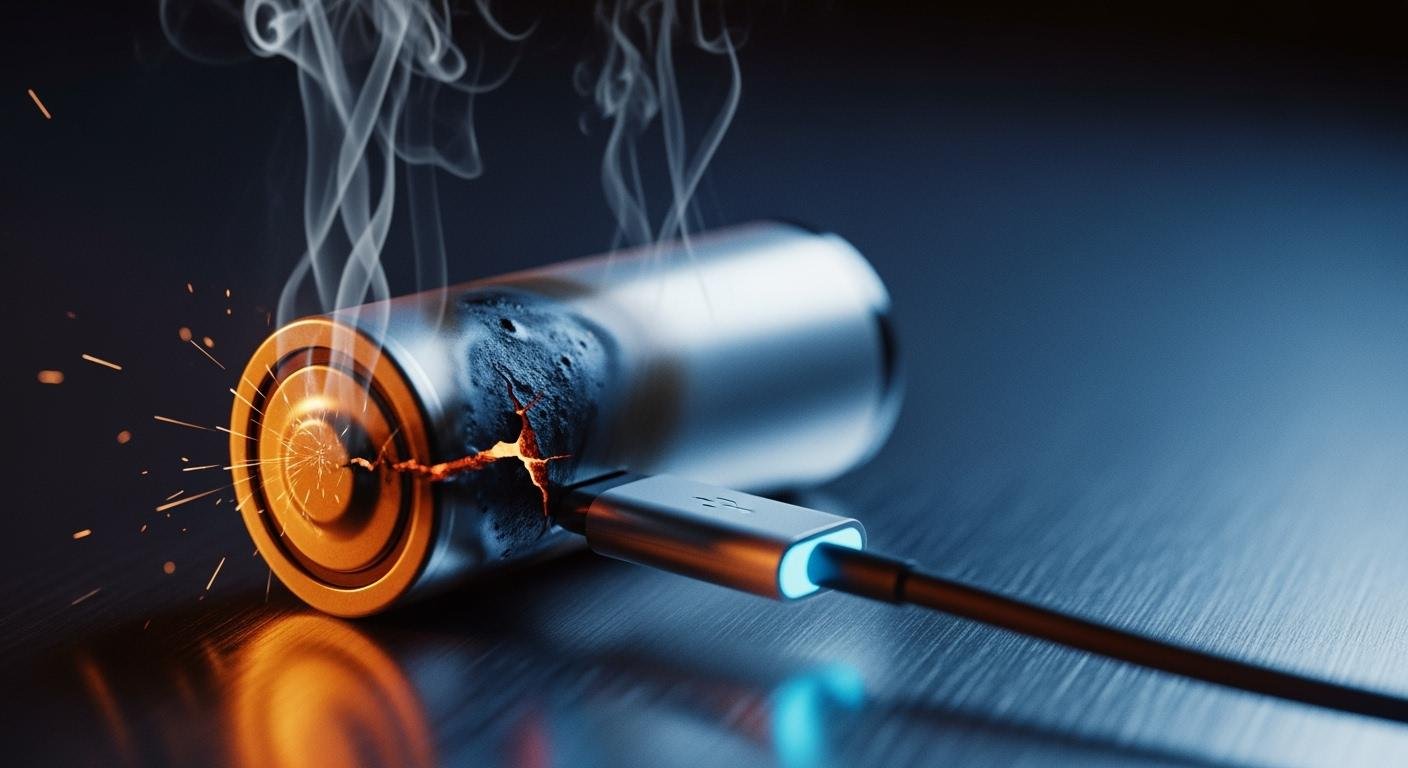
You might think any old charger will do, but this assumption is a dangerous mistake. Using a lead-acid battery charger on your new lithium battery creates major safety and performance risks. This incompatibility issue can cause over-voltage damage or prevent a full charge on the battery. With lithium-ion now powering 85% of the energy storage market, and some studies showing up to 30% of battery fires happen during charging, this problem is widespread. You must use the correct charger to safely charge lithium batteries because they require fundamentally different charging algorithms.
Immediate Risks of an Incompatible Charger
You expose your expensive lithium battery to immediate and irreversible damage when you use the wrong charger. Many chargers designed for lead-acid batteries have automatic features that are catastrophic for lithium chemistry. These features create a high-voltage situation that can destroy your battery in seconds.
The Danger of Equalization Mode
Many lead-acid chargers include an automatic “equalization” or “desulfation” mode. This function is helpful for older battery technology. Its purpose is to:
- Remove sulfate crystals from lead plates.
- Balance the acid concentration.
- Extend the life of a lead-acid battery.
To do this, the charger sends a controlled overcharge, a high-voltage spike often exceeding 15 volts, into the battery. This process is extremely dangerous for a lithium battery. The internal components cannot handle such high voltage.
Over-Voltage and BMS Damage
Your lithium battery contains a vital component called the Battery Management System (BMS). The BMS is the battery’s brain. It protects the cells from over-charging, over-discharging, and overheating. However, the BMS has its limits.
The maximum safe charging voltage for a common 12V LiFePO4 battery is exactly 14.6V. This specific voltage ensures that all four internal cells charge safely to their peak of 3.65V each. A lead-acid charger’s equalization spike of 15V or more far exceeds this critical safety limit. This extreme over-voltage can instantly overwhelm and fry the sensitive electronics of the BMS.
🚨 Critical Alert: A damaged BMS is a catastrophic failure. It renders your entire battery useless and eliminates all built-in safety protections. This turns your battery into an expensive paperweight.
The correct charging process requires precise voltage control. Using the wrong charger ignores these essential rules.
| Charging Type | Correct 12V LiFePO4 Voltage |
|---|---|
| Bulk Charging Voltage | 14.6V |
| Float Charging Voltage | 13.5V |
| Equalize Charging Voltage | 14.6V |
As you can see, even the “equalize” setting for a proper lithium charger maintains the safe maximum of 14.6V. It is not the dangerous high-voltage spike found in a lead-acid charger. This makes choosing the right charger essential for the health and safety of your battery.
How Incorrect Charging Degrades Your Lithium Battery
Beyond the immediate risk of frying your BMS, using the wrong charger slowly poisons your lithium battery. The damage is not always instant. Instead, it accumulates over time, permanently reducing your battery’s capacity and lifespan. This slow degradation happens because a lead-acid charger’s methods are fundamentally incompatible with what a lithium battery needs to stay healthy.
The Flaw in ‘Float’ Charging
Lead-acid chargers use a feature called “float charging.” This process helps maintain a full charge in a lead-acid battery.
- It applies a continuous, low-power voltage.
- This counteracts the battery’s natural self-discharge.
- It keeps the battery ready for use at all times.
However, this same process is harmful when you try to charge lithium batteries with it. A lithium battery does not need or want a continuous float charge. Once it is full, the charging process should stop completely. Subjecting a lithium battery to a constant float voltage keeps its cells in a high-stress state. Studies show this continuous charging, even at low power, causes severe capacity loss. It creates resistive films over tiny cracks in the electrodes, which increases internal resistance and makes parts of the battery wear out unevenly.
小贴士 A proper lithium charger will automatically stop the current once the battery is full. It does not use a continuous float stage, which protects your battery from unnecessary stress and aging.
Why Cell Balancing Fails
Your lithium battery pack is made of multiple individual cells connected together. For your battery to work correctly, every cell must have the same voltage level. This is called cell balancing. A healthy, balanced battery provides maximum performance and a long lifespan. The BMS manages this critical task.
The BMS typically performs this balancing act only when the cells are near a full charge, usually when their voltage exceeds a specific threshold like 3.4V or 3.5V. It needs the charger to hold the battery at this high voltage long enough to shuffle energy between the cells and even them out.
A lead-acid charger prevents this from happening. Its charging profile is not designed to hold the specific voltage needed for balancing. Many enter a “sleep” mode and will not wake up until the battery voltage drops significantly. This means your battery rarely, if ever, reaches the state where the BMS can do its job. Over time, this leads to serious problems:
- Decreased Lifespan: The entire battery’s health is determined by its weakest cell. An imbalance of just 5% can reduce your battery’s lifespan by over 30%.
- Reduced Capacity: You lose access to the battery’s full power because the BMS will shut down charging or discharging to protect the weakest or strongest cell, even if other cells are fine.
- Safety Hazards: In extreme cases, a severe imbalance can push individual cells into dangerous states, increasing the risk of failure.
The Wrong Charging Curve
To safely charge lithium batteries, you must use the correct charging algorithm, or “curve.” A lithium battery uses a simple and effective two-stage process called CC/CV (Constant Current/Constant Voltage).
- Constant Current (CC): The charger provides a strong, steady current. This “bulk” phase quickly brings the battery up to about 90% of its capacity.
- Constant Voltage (CV): Once the battery voltage hits its peak (e.g., 14.6V), the charger holds that voltage steady. The current gradually drops off as the battery tops off and the cells balance. The charging process stops when the current is near zero.
A lead-acid charger uses a more complex, three-stage profile that is unsuitable for lithium chemistry.
| Charging Stage | Lithium (CC/CV) Profile | Lead-Acid Profile |
|---|---|---|
| Stage 1 | Constant Current: Fast charging to ~90% | Bulk: Charges to ~70-80% |
| Stage 2 | Constant Voltage: Holds peak voltage, current drops | Absorption: Holds voltage, but for too long |
| Stage 3 | Charging Stops: No float needed | Float: Applies continuous voltage |
The lead-acid charger’s “absorption” stage often lasts too long, and its “float” stage is damaging. This incorrect charging profile fails to properly fill the battery, prevents cell balancing, and ultimately shortens the life of your expensive investment.
How to Safely Charge Lithium Batteries
You can avoid all these risks by ensuring you use the correct equipment. Safely charging your lithium battery is straightforward when you know what to look for. Your primary goal is to match the charger to your battery’s specific needs.
Identifying a Lithium-Ready Charger
You should first inspect the charger itself. A dedicated lithium battery charger will clearly state its compatibility on its label or packaging. Some universal chargers can handle multiple chemistries, but you must select the correct setting. These multi-function chargers often have a mode switch or button for “Lithium” or “LiFePO4.”
To confirm compatibility, you need to check a few key details. A proper charger for your lithium battery must meet these requirements:
| Criterion | 说明 |
|---|---|
| Chemistry Compatibility | The charger must be designed for your specific lithium chemistry (e.g., LiFePO4). |
| Charger Voltage | The charger’s output must match your battery pack’s voltage (e.g., 14.6V for a 12V LiFePO4 battery). |
| Charging Algorithm | It must use a CC/CV (Constant Current/Constant Voltage) algorithm and stop charging when full. |
Look at the specifications on the battery charger. For a 12V LiFePO4 battery, you want to see a maximum or bulk charging voltage of 14.6V. A charger that lists a “float” voltage or an “equalization” voltage over 14.6V is not the right tool for the job. You need a special charger that respects these limits.
When in Doubt, Contact the Manufacturer
If you are ever unsure, the safest action is to contact the battery manufacturer directly. They can give you a definitive answer and often recommend specific charger models. Before you call or email, you should gather some key information from your battery’s data sheet to make the process easier. Have the battery model, standard voltage, and chemistry (e.g., LiFePO4) ready.
Prepare a list of questions to ensure you get all the information you need. You should ask:
- What is the battery’s exact chemistry?
- Does the charger’s output voltage match my battery?
- Can this charger handle multiple battery types if I need it to?
- Does the charger monitor temperature during charging?
You can often find charger recommendations in the “Knowledge Base” or “Chargers & Accessories” section of the manufacturer’s website. Taking this extra step helps you correctly charge lithium batteries and protects your investment.
💡 小贴士 Always check the battery label and charger specifications before charging. Using a non-original charger can void your warranty and create serious safety risks.
You now understand the serious risks of improper charging. Using the wrong charger can instantly destroy your battery’s BMS or slowly degrade its capacity. The only way to safely charge lithium batteries is to use a charger made for their specific chemistry. This ensures your battery performs well and lasts a long time.
A proper charger is a small investment. It protects your much more expensive battery from permanent damage. Make the smart choice to ensure safety and longevity.
常见问题
Can I use a “smart” charger on my lithium battery?
You can only use a “smart” charger if it has a specific mode for lithium batteries (e.g., LiFePO4). A standard “smart” charger for lead-acid batteries will use the wrong charging profile. This can damage your battery’s BMS and reduce its lifespan.
What if I use a charger with a lower voltage?
Using a lower voltage charger is not a safe workaround. Your battery will never reach a full charge. This prevents the BMS from balancing the cells. Over time, this imbalance will permanently reduce your battery’s capacity and performance.
Is it safe to leave my lithium battery on the charger?
Yes, it is safe if you use a proper lithium charger. These chargers automatically stop the current when the battery is full. You should never leave your battery connected to a lead-acid charger, as its continuous “float” stage will cause damage.
💡 请记住 A correct lithium charger protects your battery from overcharging. It knows exactly when to stop.
What happens if I accidentally damage the BMS?
A damaged Battery Management System (BMS) is a critical failure. Your battery will stop working and lose all its safety protections against overcharging or overheating. You cannot repair a fried BMS. The entire battery becomes an unusable and potentially hazardous paperweight.
 EN
EN ES
ES FR
FR DE
DE RU
RU ZH
ZH