

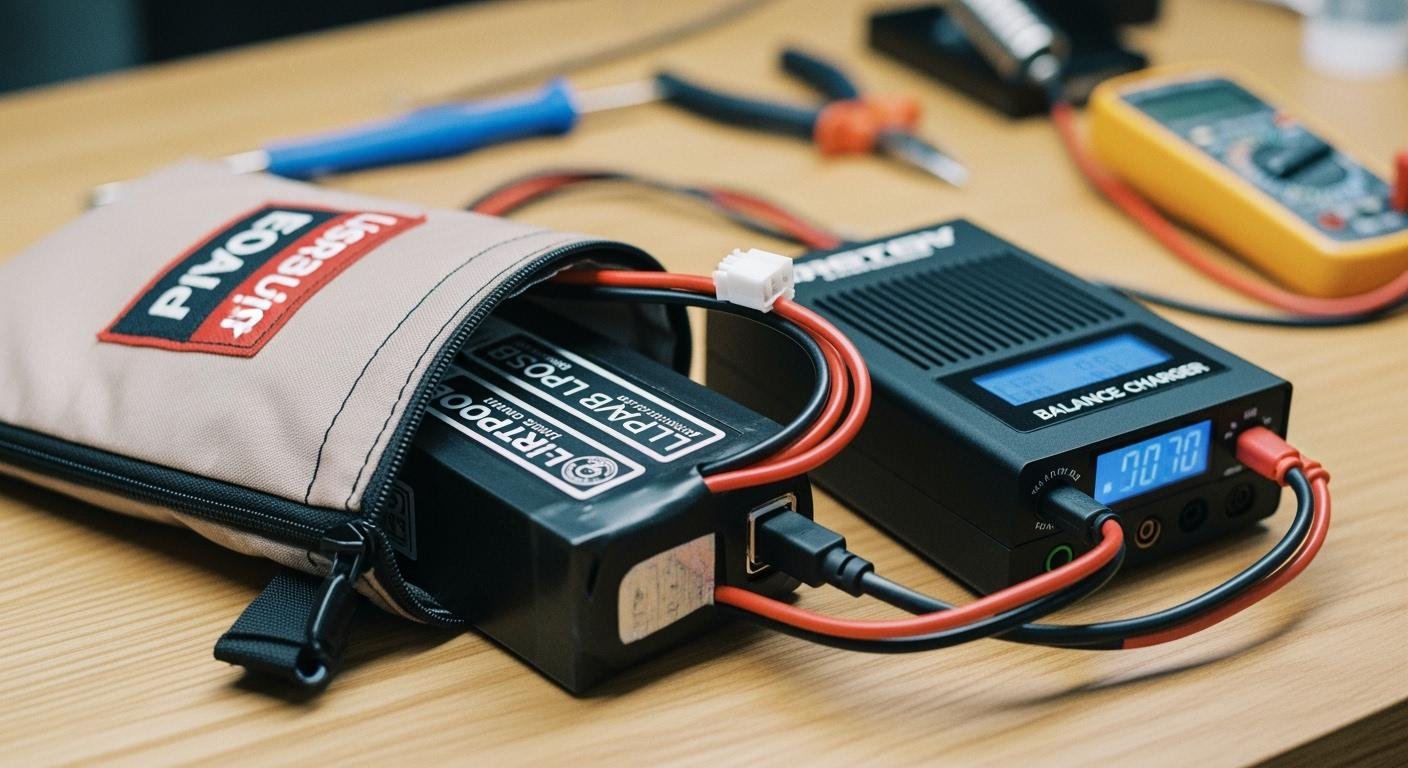
You must prioritize LiPo safety to charge a LiPo battery. To charge LiPo batteries safely, you must follow five non-negotiable rules. This is the foundation for every LiPo charging session. Your charger is a powerful tool; use it correctly.
Your Safety Foundation: 5 Critical LiPo Rules 🚨
- Always use a dedicated LiPo balance charger.
- Never leave a charging LiPo battery unattended.
- Charge your LiPo in a fire-resistant location.
- Set the correct charger settings for the LiPo.
- Stop charging immediately if the battery swells.
Essential Gear to Charge LiPo Batteries Safely
You need the right equipment to charge LiPo batteries safely. Using the correct gear provides critical layers of protection and helps you monitor the health of your LiPo battery. Investing in these items is an investment in your safety.
Select a LiPo Balance Charger
You must use a dedicated LiPo balance charger. A standard charger cannot do this job. A balance charger monitors and adjusts the voltage of each individual cell inside the LiPo pack during charging. This ensures every cell reaches the same voltage, which is vital for battery health and safety. A quality charger also includes essential safety features.
Many modern chargers offer features like:
- Automatic shutoff to prevent overcharging.
- Real-time cell monitoring to spot issues early.
- Thermal sensors for temperature protection.
Popular and reliable charger models include the Spektrum S2200 G2 and the Dynamite Passport P4. A good charger is your first line of defense.
Use a Fire-Resistant LiPo Bag
You should always place your LiPo battery in a fire-resistant container during charging. A LiPo safety bag is an inexpensive and effective tool designed for this purpose. These bags are built to contain a fire if your LiPo fails.
This safety bag is typically made of multiple layers for maximum fire protection:
- Outer Layer: A durable, silicone-coated fiberglass.
- Middle Layer: A flame-retardant core material.
- Inner Layer: An aluminum-coated fiberglass fabric.
This construction can resist extreme heat, often up to 1800°F (982°C), giving you precious time to react to an emergency.
Check Cells with a Voltage Checker
A LiPo voltage checker is a small but powerful diagnostic tool. Before you charge a LiPo battery, you should use a checker to see the voltage of each cell. This simple step tells you if the LiPo is healthy and safe for charging. A good checker offers high accuracy, often within ±0.01V, and an audible alarm to warn you of low voltage.
Voltage Health Check ⚡ A healthy LiPo cell has a usable voltage between 3.2V and 4.2V. Never attempt to charge a LiPo if any cell is below 3.2V, as this can cause permanent damage. Many smart chargers will recognize this danger and refuse to start the charging cycle if a cell is too low.
How to Charge a LiPo Battery Step-by-Step
Following a consistent, step-by-step routine is the best way to charge LiPo batteries safely. This process turns safety from a thought into a habit. Each step provides a layer of protection for you and your equipment.
Step 1: Prepare a Safe Charging Area
You must first create a dedicated safe zone for charging. Your choice of location is a critical safety decision. Never charge on or near flammable materials.
Unsafe Charging Surfaces 🚫 Avoid soft surfaces like carpet, wood, or a cluttered workbench. A fire on these surfaces can spread quickly, making a bad situation much worse.
Your ideal charging area should have these features:
- A Fire-Resistant Surface: Use a concrete floor, ceramic tile, or a metal tray.
- Good Ventilation: Proper airflow helps dissipate heat. It is also essential for venting smoke away from you in an emergency. LiPo smoke is toxic.
- Stable Temperature: Charge your LiPo in an area with an ambient temperature between 65°F and 122°F. Charging a cold LiPo (below 50°F) can cause damage.
Step 2: Perform a Pre-Charging Safety Check
You should inspect your LiPo battery before every charge. This pre-charging safety check helps you spot damage before it becomes a hazard. Never attempt to charge a damaged LiPo.
Look for these warning signs:
- Puffing or Swelling: A healthy LiPo is flat. A puffed LiPo looks swollen or “tight as a drum.” This happens when the electrolyte inside turns to gas, indicating internal damage.
- Physical Damage: Check for dents, punctures, or deep scratches on the battery’s casing.
- Frayed Wires or Damaged Connectors: Exposed wires or broken connectors can cause a dangerous short circuit.
If you find any of these issues, do not charge the LiPo battery. Set it aside for proper disposal.
Step 3: Connect the Battery and Balance Leads
Properly connecting your LiPo to the charger is essential. Most LiPo batteries have two sets of connectors: a main power lead and a smaller balance lead. Your charger needs both for a safe, balanced charge.
- Plug the Main Lead: Connect the battery’s main power lead to the corresponding port on your charger.
- Plug the Balance Lead: Connect the battery’s balance lead to the balance port on the charger. This allows the charger to monitor each cell individually.
There are several common connector types. You must ensure your charger and battery have matching connectors or use a reliable adapter.
| Тип разъема | Current Rating (Continuous) | Типовые применения |
|---|---|---|
| XT-60 | 30-60 amps | Most 1/10 scale RC vehicles, drones |
| Deans (T-Plug) | 60-75 amps | Many 2S-3S RC car applications |
| EC-5 | Up to 120 amps | High-power 1/8 scale models |

Finally, place the connected LiPo battery inside your fire-resistant safety bag before you proceed.
Step 4: Configure Charger Settings
You must configure your charger with the correct settings for your specific LiPo. Using incorrect settings is one of the main causes of LiPo fires. Always double-check your settings before starting the charging process.
- Charging Program: Select the “LiPo Balance Charge” mode. This ensures the charger uses the balance lead for safety.
- Cell Count (Voltage): Set the charger to match the cell count of your battery (e.g., 2S for 7.4V, 3S for 11.1V). Setting this incorrectly is extremely dangerous. A charger trying to charge a 3S LiPo on a 4S setting will push the voltage over the safe limit of 4.2V per cell, which can cause a fire.
- Charge Rate (Amperage): The standard safe charge rate is “1C.” The “C” stands for capacity. A 1C rate means you set the charge current (in amps) to match the battery’s capacity (in amp-hours).
Calculating a 1C Charge Rate 💡 To find the 1C rate, take the battery’s capacity in milliamp-hours (mAh) and divide by 1000.
- A 5000 мАч LiPo has a 1C charge rate of 5.0A.
- A 5800mAh LiPo has a 1C charge rate of 5.8A.
Your charger uses a method called Constant Current-Constant Voltage (CC-CV). First, it applies a constant current (the 1C rate you set). Once the cells near 4.2V, the charger switches to a constant voltage, and the current slowly drops as the LiPo fills up. This is the safest way to charge a LiPo battery.
Step 5: Start and Monitor the Charge
With everything prepared and configured, you can begin charging. This final step requires your full attention.
- Start the Charger: Confirm the settings one last time and start the charging cycle. Most smart chargers require a long press to confirm and begin.
- Stay and Observe: This is the most important rule. Never walk away from a charging LiPo battery. Stay within sight and earshot of the charger.
- Perform Active Monitoring: Watch the charger’s display for information about cell voltage and total charge. Listen for any unusual sounds from the charger or battery. Watch for any signs of swelling. If your charger displays an error, like flashing red lights, it has detected a problem. Stop the charging process immediately.
This active monitoring is your final and most important layer of safety. It allows you to react instantly to any problem during the charging process.
Emergency Safety Procedures
You can stay safe even if something goes wrong during the charging process. Knowing how to react in an emergency provides the ultimate protection. You must act quickly and correctly.
Recognize Critical Warning Signs
You need to know the signs of a failing LiPo battery. When a LiPo is overcharged, the electrolyte inside creates gas, causing the battery to swell up. This is a major danger signal.
Critical Dangers to Watch For ⚠️
- Puffing or Swelling: The LiPo looks bloated or tight.
- Hissing Sounds: Audible hissing means the LiPo containment is broken and flammable gases are escaping.
- Sweet, Sickly Smell: This odor indicates leaking electrolyte.
- Excessive Heat: The LiPo feels unusually hot to the touch.
If you notice any of these signs, you must treat the situation as an emergency. Your immediate safety depends on your next actions.
Execute an Emergency Shutdown
You must stop the charging process immediately if you detect a problem. Your goal is to cut power to the LiPo as safely as possible.
- Stop the Charger: Press the stop button on your charger to end the charging cycle.
- Unplug the LiPo: If it is safe to do so, carefully unplug the LiPo battery’s main and balance leads from the charger.
- Move to Safety: Leave the LiPo in its fire-resistant bag and move it to a safe outdoor location, like a concrete surface away from flammable objects. Do not touch the LiPo with your bare hands if it is hot or swelling.
Handle a Compromised Battery
You cannot use a damaged LiPo again. You must safely discharge it before disposal. Never use saltwater for discharging, as this method is unreliable and can be dangerous.
Safe Discharge and Disposal Steps ♻️
- Connect a DC light bulb, like a car tail light, to the damaged LiPo.
- Place the LiPo and bulb in a safe, fire-resistant location and let the bulb drain the battery completely. This may take several hours.
- Once the LiPo is at 0 volts, it is inert. You can then take it to a proper disposal facility.
Check your local rules for battery disposal. Many communities require you to take any LiPo to a hazardous waste facility. Some recycling centers, like Best Buy or Home Depot, also accept batteries.
You can charge a LiPo battery safely by making safety a habit. Use this checklist for every charging session to protect your LiPo and yourself.
Your Safe Charging Checklist ✅
- Осмотритесь: Check your LiPo for any damage or swelling.
- Contain: Always place the LiPo battery in a LiPo safety bag.
- Configure: Set your charger to the correct cell count and 1C rate.
- Store: Keep your LiPo at a nominal voltage of 3.7V-3.9V per cell for storage.
Remember the most important rule. As Fire and Rescue NSW warns, “Никогда не оставляйте заряженные батареи без присмотра.” Your attention is the best safety feature for your charger and LiPo.
ЧАСТО ЗАДАВАЕМЫЕ ВОПРОСЫ
What does “storage charge” mean?
You use a storage charge to prepare your LiPo for long-term storage. This special charger function brings each cell to its nominal voltage. It is not a full charge.
Storage Voltage 🔋 A proper storage charge leaves each cell between 3.7V and 3.9V. This protects the battery’s internal chemistry.
Can I charge a LiPo faster than 1C?
You should always charge at 1C for maximum safety and battery life. Some batteries are rated for faster charging, but you must check the label first. For beginners, sticking to the 1C rate is the safest practice.
What should I do if my battery gets wet?
You must not use or charge a wet LiPo battery. Water can damage the internal electronics and cause a dangerous short circuit. You should safely discharge the battery and take it to a proper disposal facility.
How long does it take to charge a LiPo?
Charge time depends on a few factors:
- The battery’s capacity (mAh)
- Your selected charge rate (amps)
- The battery’s starting voltage
Charging a mostly empty battery at a 1C rate usually takes about one hour.
 EN
EN ES
ES FR
FR DE
DE RU
RU ZH
ZH