

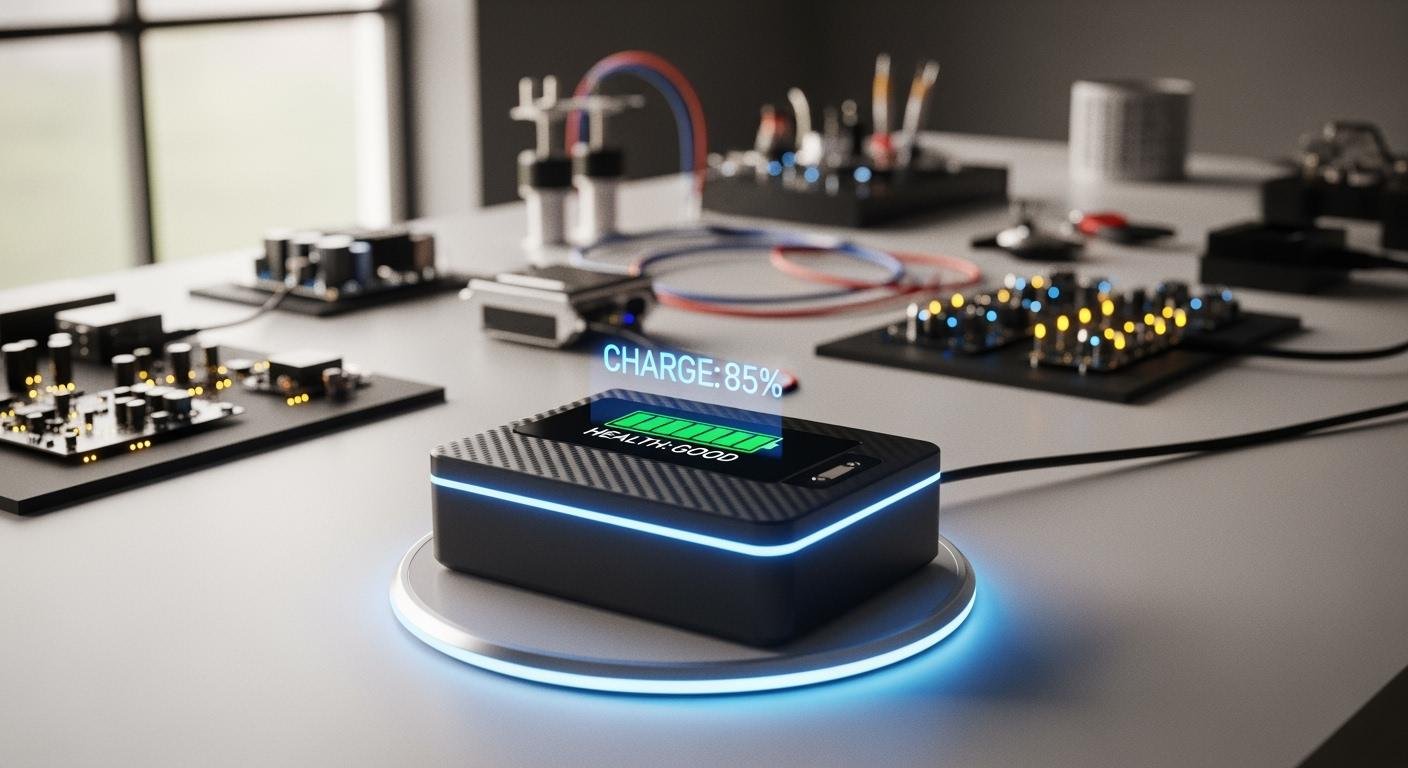
You want to charge a li polymer battery safely. With the FPV and RC hobby markets expanding rapidly, knowing how to charge lipo batteries is a critical skill. Your success with any lipo battery depends on one core formula. This 2026 guide provides the clear steps you need for your lipo.
The Golden Rule 💡: Always use a dedicated lipo balance charger. You must set the correct cell count and charge rate on your charger.
Mastering your charger ensures the health and longevity of every lipo battery.
Gear and Pre-Charge LiPo Prep
Before you connect any battery, you must prepare your gear and inspect your lipo. This pre-flight check is the most important step for safe charging. It prevents accidents and protects your equipment.
Your Essential Charging Toolkit
You need the right tools for the job. Using an incorrect charger is a primary cause of lipo battery fires. Only a dedicated lipo balance charger is acceptable. A quality charger is an investment in safety.
Your 2026-era charger should have key features:
- Individual Cell Monitoring: Tracks each cell’s voltage for a perfect balance.
- Multiple Protections: Includes safeguards against overcurrent, overvoltage, and overheating.
- Cell Compatibility: The charger must support your lipo battery’s cell count (e.g., 4S, 6S).
- Clear Display: An intuitive screen helps you confirm settings easily.
Modern chargers from brands like SKYRC and Haisito offer these protections. Look for chargers that meet international safety standards.
| Сертификация | Описание |
|---|---|
| IEC62133 | International standard for battery safety. |
| UN38.3 | Ensures safety during air transport. |
Read Your LiPo Battery Label (S, mAh, V)
Your lipo battery label tells you everything the charger needs to know. You must understand these three values.
- Количество клеток (S): This number tells you how many cells are in the lipo pack. A “4S” lipo has four cells. The charger voltage setting must match this number.
- Емкость (мАч): This is the battery’s fuel tank, measured in milliamp-hours. This value helps you set the charge current. A 1C charge rate for a 5000mAh lipo is 5.0 amps.
- Напряжение (В): The nominal voltage is determined by the cell count. Each lipo cell has a nominal voltage of 3.7V.
| S-Configuration | Номинальное напряжение (В) |
|---|---|
| 4S | 14.8 |
| 6S | 22.2 |
| 8S | 29.6 |
Note for Beginners 📝: You should always fully charge a brand-new lipo battery before its first use. This helps calibrate the cells for a long service life.
Spotting a Damaged LiPo
Never charge a damaged lipo. A pre-charge inspection takes only a few seconds. Look for any physical signs of damage. A healthy lipo is firm and rectangular.
Signs of a bad lipo include:
- Puffing: The battery looks swollen or rounded.
- Squishy Feel: The battery feels soft when you gently press it.
- Punctures: Any visible cuts or dents in the outer wrapping.
- Sweet Smell: A distinct chemical odor indicates an internal leak.
If you find a damaged lipo, do not use or charge it. Place it in a fireproof container with sand and take it to a designated battery recycling center.
How to Charge LiPo Batteries Safely

You are now ready for the ideal charging procedure. Your smart charger uses a sophisticated charging method to protect your lipo. It’s called the Constant Current – Constant Voltage (CC-CV) algorithm. First, the charger supplies a steady flow of power (constant current). This quickly raises the battery’s voltage. As the lipo nears its peak voltage, the charger switches tactics. It holds the voltage steady (constant voltage) and reduces the current until the battery is full. This two-phase charging process is the safest way to charge lipo batteries.
Select the LiPo Balance Charge Mode
Your first step on the charger is to select the correct program. You will almost always use the “Balance Charge” mode. This is the most important setting for lipo health and safety.
Why is this mode so critical?
- It monitors each cell. A lipo battery is a pack of individual cells. The balance charge mode uses the small white balance plug to check the voltage of every single cell.
- It prevents imbalance. The charger ensures every cell reaches the same voltage (4.2V) at the same time. This prevents some cells from overcharging while others are undercharged.
- It maximizes lifespan and safety. A balanced lipo is a healthy and stable lipo. Using this mode every time you charge lipo batteries reduces the risk of fire and extends the battery’s service life.
Other modes like “Fast Charge” or “Плата за хранение” exist for specific purposes. However, for your routine full charging process, “Balance Charge” is the non-negotiable standard.
Set Voltage to Match Cell Count
Next, you must tell the charger what kind of lipo you have. You do this by setting the voltage to match the battery’s cell count. Your charger will show options like 4S (14.8V) or 6S (22.2V). You must select the option that matches your lipo label.
Each cell in your lipo has specific voltage levels you should know:
- Fully Charged Voltage: 4.2V
- Номинальное напряжение: 3.7V
- Напряжение хранения: 3.8V
Your charger uses the fully charged voltage to calculate the pack’s total voltage.
| Количество клеток | Номинальное напряжение | Fully Charged Voltage |
|---|---|---|
| 4S | 14.8V | 16.8V |
| 6S | 22.2V | 25.2V |
Safety Check ⚠️: Setting the wrong cell count is extremely dangerous. For example, charging a 4S lipo on a 6S setting will cause it to overcharge, swell, and likely catch fire. Always double-check this setting.
Set Amperage for the C-Rate (1C to 5C)
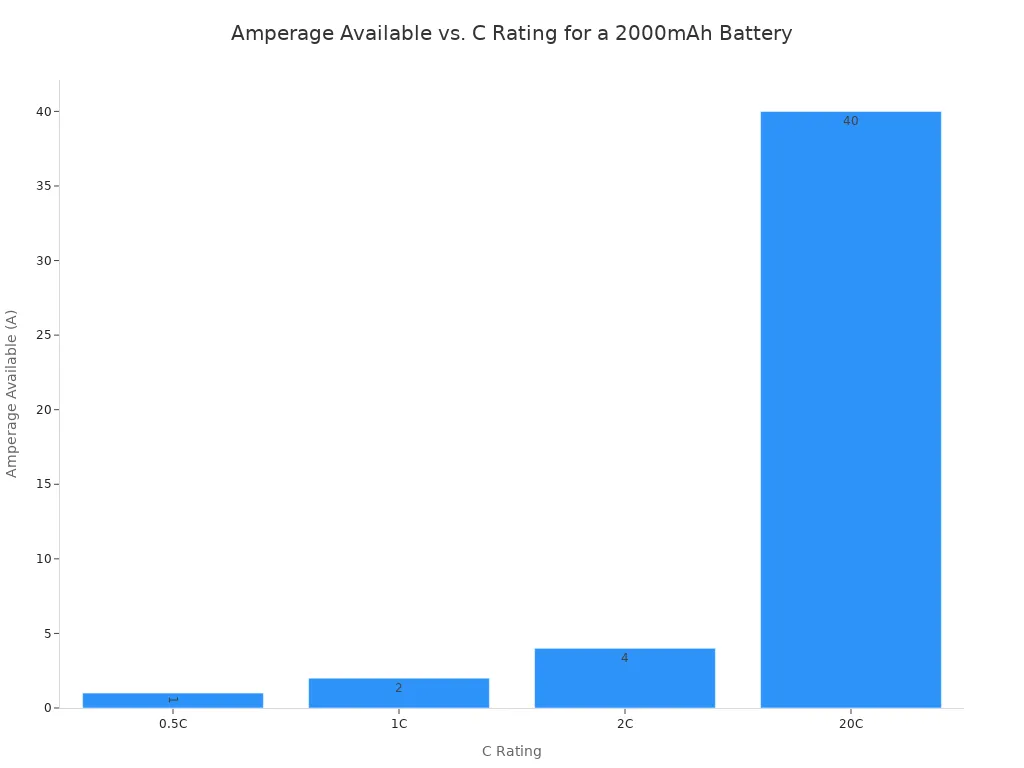
Now you need to set the charge current, measured in amps (A). This is determined by the battery’s C-Rate. The standard, safest charge rate is “1C”. A 1C rate charges a battery in about one hour.
To find the 1C amperage, you convert your lipo battery’s capacity from milliamp-hours (mAh) to amps. You do this by dividing the mAh by 1000.
- A 5000mAh lipo has a 1C charge rate of 5.0A (5000 / 1000 = 5).
- A 2200mAh lipo has a 1C charge rate of 2.2A (2200 / 1000 = 2.2).
Some modern lipo batteries are rated for a faster charging method, like 3C or 5C. A 5C charge rate could charge a lipo in as little as 12-15 minutes. However, you should only use a rate higher than 1C if the battery manufacturer explicitly lists a “Max Charge Rate” on the label. Sticking to 1C is always the safest bet for battery longevity.
Connect the Battery Leads Correctly
With your charger settings confirmed, it’s time to connect the lipo. The connection order is crucial for safety and preventing errors.
The Correct Connection Order 🔌
- Connect the Main Power Leads: Plug the battery’s main connector (usually a large XT60 or XT90) into the charger. Red goes to positive (+), and black goes to negative (-).
- Connect the Balance Lead: Plug the battery’s small white balance connector into the correct port on your charger. The port will be labeled for your lipo’s cell count (e.g., 4S, 6S).
Connecting in this order helps the charger properly detect the battery before initiating the charging process. If you connect the balance lead first, some chargers may show a “CONNECTION BREAK” error.
Start and Monitor the Charge
You are now ready to charge a li polymer battery. Place the lipo inside a fireproof bag or container. Double-check all your settings on the charger’s screen one last time: Balance Charge mode, correct cell count, and correct amperage.
Once you are confident, press and hold the start button on your charger. Most chargers require a long press as a final safety confirmation. The charger will begin its constant current phase, and you will see the voltage and amperage readings on the screen.
Your job is not done.
- Never leave a charging battery unattended. Stay in the room and keep an eye on it.
- Periodically check the battery. Occasionally feel the side of the lipo. It may get slightly warm, but it should never get hot.
- Listen for the beep. Your charger will sound an alarm when the charging is complete.
Following these steps is how you charge lipo batteries safely and effectively, ensuring you get the most out of every pack. This is the best way to charge a li polymer battery.
Post-Charge and Storage Best Practices
Your charger has beeped, and the screen says “FULL.” Your work is not over. Proper post-charge handling and storage are just as important as the charging process itself. Following these steps will protect your lipo and maximize its lifespan.
Safely Disconnect Your Battery
You must disconnect your lipo battery correctly once charging is complete. The disconnection order is the reverse of the connection process. This simple sequence prevents accidental shorts.
- First, unplug the main power lead (the XT60 or XT90 connector) from the charger.
- Next, carefully unplug the small white balance lead from its port.
- Finally, remove the lipo from its fireproof bag or container.
Your fully charged lipo is now ready for action.
Use vs. Storage: The Two Charge States
A lipo battery has two main states after charging: ready-for-use and ready-for-storage. You must understand the difference. A fully charged lipo (4.2V per cell) is chemically volatile and under stress. You should only leave a lipo in this state if you plan to use it within 24 hours.
Critical Safety Rule 🚨: Never store a fully charged lipo for more than a day. Leaving a lipo at full voltage for long periods will degrade its cells, reduce its capacity, and can cause it to swell.
If your plans change, you must prepare the lipo for storage.
LiPo Storage Charge (3.8V/Cell)
The “Storage Charge” mode on your charger is your lipo battery’s best friend for long-term health. This function automatically brings each cell to its ideal storage voltage of approximately 3.8V. This voltage level is the most stable state for a lipo. A proper storage charge significantly extends the number of charging cycles your lipo can handle.
When storing your lipo, you must also control its environment.
- Store your lipo in a прохладное, сухое место.
- Keep the lipo away from heat sources like direct sunlight or radiators.
- Never let your lipo come into contact with liquids.
A fireproof lipo bag is the perfect place to store your lipo.
| Количество клеток | Ideal Storage Voltage |
|---|---|
| 4S | 15.2V |
| 6S | 22.8V |
Troubleshooting Common Charging Issues
Even with a perfect setup, you might face an error. Most issues are simple to fix. This guide helps you diagnose and solve common problems you may encounter when charging a lipo.
Fixing a “Connection Error”
A “Connection Error” or “CONNECTION BREAK” message is a frequent issue. Your charger displays this when it cannot detect the battery correctly. You can usually fix this quickly.
- Check Your Leads: Ensure the main power and balance leads are plugged in securely. A loose connection is the most common cause.
- Verify Connection Order: You should always connect the main power lead first, then the balance lead. Disconnect both and try again in the correct sequence.
- Осмотрите на предмет повреждений: Look for broken wires or damaged pins on your lipo connectors and charger ports. A damaged lead will prevent a good connection.
When Battery Cells Won’t Balance
Your charger may struggle to balance the cells in an older lipo. A small voltage difference between cells is normal. However, a large gap signals a problem.
- A difference of 0.05V (50mV) is common.
- A difference of 0.1V (100mV) is acceptable.
- A difference over 0.7V (700mV) indicates a serious issue with the lipo.
If your charger repeatedly fails to balance a lipo, you can use a multimeter to check each cell’s voltage directly. This helps you see if the problem is with the lipo or the charger. A persistent imbalance often means a cell is failing.
Reviving a Dead LiPo Safely
You may find a lipo with a voltage below 3.0V per cell. This lipo is over-discharged and very unstable. Attempting to revive it is extremely risky and can cause a fire.
Warning ⚠️: Never leave a reviving lipo unattended. The cells are unstable and the risk of fire is high.
If you choose to proceed, you must do so with extreme caution.
- Set your charger to a very low current, around 10-20% of the battery’s 1C rate. For a 2200mAh lipo, this is just 0.2A to 0.4A.
- You may need to use a NiMH charge setting to start, as many smart chargers block charging a lipo below a certain voltage.
- Monitor the lipo constantly for heat or puffing. Once the voltage is above 3.0V per cell, you can switch back to the LiPo Balance Charge mode.
When to Retire a Battery
Every lipo has a limited lifespan. You must know when to retire a battery for safety. Continuing to use a failing lipo is dangerous.
You should immediately stop using a lipo if you see these signs:
- Puffing: The battery is swollen or feels soft.
- Poor Performance: The battery no longer holds a charge or has very short run times.
- Excessive Heat: The lipo gets very hot during charging or use.
- Cell Imbalance: The cells will not balance, even after troubleshooting.
A damaged or worn-out lipo is a hazard. You must dispose of it at a proper battery recycling facility.
You can master how to charge a li polymer battery. Your safety depends on a few key rules.
- Всегда используйте fire-resistant lipo bag.
- Never leave a charging battery unattended.
- Always inspect your lipo before the charging process.
Your charger is your most important tool. You must use the “Balance Charge” mode on your charger. Set the correct voltage and a 1C amperage. Use the “Storage Charge” function on your charger for any battery not used within a day. Following these steps is how you charge lipo batteries safely and maximize their lifespan.
ЧАСТО ЗАДАВАЕМЫЕ ВОПРОСЫ
What if I don’t have a LiPo bag?
You must use a fire-resistant container. A LiPo bag is the best option. You can also use a metal ammo can or a cinder block as a safe alternative. Never charge a LiPo on a flammable surface like a wood table or carpet. Safety is your top priority.
Can I charge my LiPo battery overnight?
No. You must never leave a charging LiPo battery unattended. The charging process requires your supervision. A fire can start quickly if a problem occurs. Always stay in the room and monitor the battery until the charge is complete.
How many times can I charge a LiPo?
You can typically charge a LiPo battery 300 to 500 times. This number depends on how well you care for it. Proper charging, discharging, and storage practices will help you get the most cycles from your battery. Retiring a battery after 300 cycles is a good safety practice.
Why is my new LiPo not at full voltage?
Manufacturers ship new LiPo batteries at storage voltage (around 3.8V per cell). This is the safest and most stable state for the battery during transport and storage.
Remember 💡: You must always perform a full balance charge on a new LiPo before you use it for the first time.
 EN
EN ES
ES FR
FR DE
DE RU
RU ZH
ZH