


A lithium polymer battery can last for 300 to over 1000 charge cycles. This translates to a lifespan of one to three years. Your battery’s actual lifespan depends on its use and care.
The lipo battery lifespan is not fixed. A lipo battery in a high-power drone has a different lifespan than a smartphone battery.
Simple habits greatly affect your lipo battery. Proper care extends the battery lifespan.
Measuring Lithium Polymer Battery Lifespan
Two main factors determine your lipo battery lifespan: usage and time. Understanding charge cycles and calendar aging helps you measure the health of your battery.
Understanding Charge Cycles
The cycle life of a battery tells you how many times it can be fully charged and discharged. A single charge cycle is not just one plug-in session. It measures a full 100% discharge of the battery’s capacity.
- A cycle is complete after the battery uses 100% of its power.
- This can happen over multiple uses. For example, using 50% of your battery today and 50% tomorrow equals one full cycle.
The expected number of charge cycles varies greatly. A lithium polymer battery in a high-stress drone might last 300-500 cycles. A faster discharge rate can shorten the battery lifespan. In contrast, a lipo battery in a smartphone often reaches 800-1200 cycles because the power demand is lower.
The Impact of Calendar Aging
A lipo battery degrades even when you are not using it. This process is called calendar aging. How you store your battery has a massive impact on its long-term health and lifespan. A fully charged lipo degrades much faster than one at a proper storage voltage.
Pro Tip: For long-term storage, keep your lipo at its storage voltage, which is around 3.8 volts per cell. This simple step can add years to its service life.
Storing a lithium polymer battery correctly minimizes capacity loss. The data below shows how storage conditions affect a battery over one year.
| Storage Condition (Temp & Charge) | Annual Capacity Loss |
|---|---|
| 40°F & 30% charge | 2% |
| 40°F & 100% charge | 5% |
| Room temperature & 100% charge | 20% |
Proper storage is key to a long lifespan for your battery.
Factors That Reduce Lipo Battery Life

Several factors can shorten your battery’s lifespan. Understanding these issues helps you protect your investment and ensure safe operation. Key problems include high temperatures, improper charging, poor storage, and physical damage.
High Temperatures
Heat is one of the biggest enemies of a lipo battery. Operating or charging a battery outside its ideal temperature range accelerates chemical breakdown. The best temperature for charging is between 41°F and 113°F (5°C to 45°C). Exposing a lipo to temperatures above 140°F (60°C) causes rapid degradation. This heat speeds up the formation of an internal layer that increases resistance and reduces the battery’s capacity.
Overcharging and Deep Discharges
Voltage management is critical for a long battery lifespan. Both overcharging and over-discharging cause permanent damage.
- Surcharge : Charging a lipo cell beyond its 4.2V limit can cause the battery to swell from gas production. It also damages internal structures, leading to permanent capacity loss and creating a fire risk.
- Deep Discharging: You should never discharge a lipo cell below 3.0V. Going below this voltage can cause irreversible damage, making the battery unable to hold a charge properly.
Improper Storage
How you store your lipo has a major impact on its health. Storing a fully charged lipo battery for extended periods is a common mistake. A high state of charge puts stress on the battery’s internal chemistry.
For long-term storage, always bring your lipo to its storage voltage of around 3.85 volts per cell. Many modern chargers have a dedicated storage function to do this automatically.
This simple step prevents significant capacity loss and extends the battery lifespan.
Dommages physiques
A physically damaged lipo is dangerous and should be retired immediately. Any compromise to the battery’s outer casing can lead to an internal short circuit and a potential fire. Look for these warning signs:
- Puffing or swelling
- Dents or deep scratches
- Cracks in the casing
- Any sign of leaking fluid
If you see any of these issues, do not use the battery. It must be taken to a proper e-waste or hazardous waste collection facility for disposal.
Maximizing Your Battery Lifespan

You can take active steps to protect your battery. Simple changes in your routine can significantly increase its service life. Following best practices for charging, temperature control, and equipment use is the key to extending lipo battery lifespan.
Maintain Proper Charge Levels
Managing your battery’s charge level is one of the most effective ways to improve its health. A lipo battery is most stressed when it is fully charged or completely empty. Keeping it in a middle range reduces this stress.
The “20-80% Rule” is a great guideline. Try to keep your battery charge between 20% and 80% for daily use. This simple habit can double your battery’s lifespan.
Here are some best practices for daily battery management.
| Meilleures pratiques | The Simple Rule | Why It Matters for Battery Life |
|---|---|---|
| Manage Charge Levels | Avoid 0% and 100%; aim for a 20-80% range. | Reduces the stress that wears out the battery. |
| Control Temperature | Charge at room temperature; avoid hot or cold. | Prevents damage from extreme heat or cold. |
| Choose Charging Speed | Use slower chargers when you have time. | Creates less heat and puts less strain on the battery. |
Many modern devices have settings to help you. You can often turn on a feature that stops charging at 80%. You can also practice “snack charging” by giving your battery short top-ups instead of one long charge.
Charge to a Lower Voltage
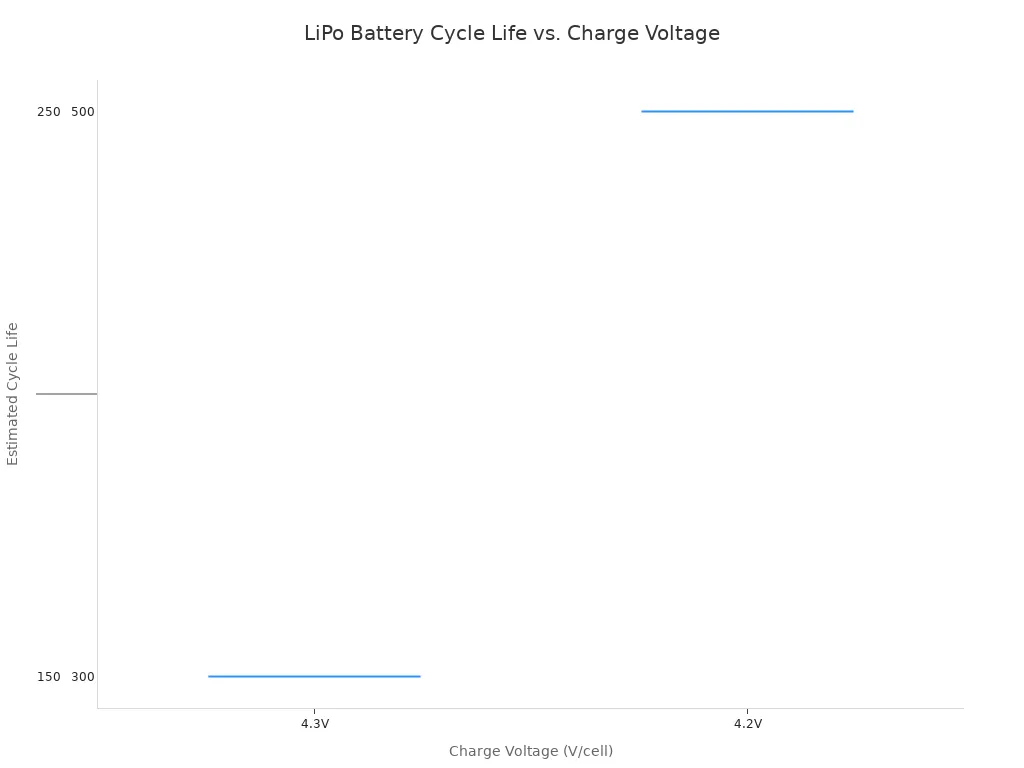
You can make a trade-off between maximum runtime and maximum lifespan. A standard lipo cell charges to 4.2 volts. Charging to a slightly lower voltage dramatically increases the number of cycles your battery can handle. You will get a little less runtime on each charge, but the overall lifespan will be much longer.
The data shows a clear benefit.
- Charging to 4.1V per cell can extend life to 600–1,000 cycles.
- Charging to 4.0V per cell can yield an incredible 1,200–2,000 cycles.
This chart shows how a small change in voltage impacts the estimated cycle life of a lipo battery.
This strategy is a powerful tool for anyone who values the long-term health of their equipment over getting every last minute of power from a single charge.
Avoid Extreme Temperatures
Temperature has a huge effect on your battery. Both extreme heat and cold can cause permanent damage.
- Heat: Never charge a lipo battery when it is hot. For example, a drone battery will be warm after a flight. Let it cool down to room temperature before you plug it in. You can help it cool by placing it in a well-ventilated area.
- Cold: Charging a lipo in cold conditions is very dangerous. Charging below 50°F (10°C) can cause irreversible damage and a complete loss of capacity. If your battery is cold, bring it inside and let it warm up to room temperature before charging.
Some advanced chargers monitor the temperature. They will automatically reduce the charge voltage in cold weather to protect the battery.
Use a Quality Balance Charger
A lipo pack often contains multiple battery cells. A balance charger is essential because it makes sure every cell in the pack has the same voltage. If the cells become unbalanced, one cell can be overcharged or over-discharged even if the pack’s total voltage seems correct.
Using a charger without a balance function is extremely risky. It was a major cause of fires in the early days of lipo technology.
Safety Warning: Failure to use a balance charger for a multi-cell lipo pack can result in fire. Always use the balance charge mode and connect the JST-XH balancing connector.
A quality balance charger is a non-negotiable tool for safety and for maximizing your battery lifespan. It is a smart investment that protects you and your equipment.
A lithium polymer battery lifespan is not fixed. It can range from 300 to over 1,200 charge cycles. Your care determines the final lipo battery lifespan. Three actions greatly extend your lipo battery lifespan:
- Keep the battery out of extreme heat.
- Store your lipo battery at the correct voltage.
- Avoid charging the battery to 100% every time.
Consistent care unlocks the full potential of your lithium polymer battery and every lipo battery. This is the key to getting the most from your investment.
FAQ
How do I know if my LiPo battery is bad? ⚠️
Look for physical signs of damage. A bad battery may be swollen, dented, or leaking. It might also get very hot during use or fail to hold a charge. You should stop using a damaged battery immediately.
How do I safely dispose of a LiPo battery?
You must dispose of LiPo batteries safely. First, fully discharge the battery. You can do this with your charger’s discharge function. Then, take it to a local e-waste collection site or a battery recycling center. Never throw it in the regular trash.
Is the “20-80 rule” really necessary?
The “20-80 rule” is not required, but it is highly recommended. Keeping your battery’s charge between 20% and 80% reduces stress on its chemistry. This simple habit can double your battery’s total lifespan, saving you money in the long run.
Can I leave my LiPo battery charging overnight?
No, you should never leave a LiPo battery charging unattended or overnight. Even with a quality charger, there is a risk of malfunction that could lead to overcharging and fire. Always monitor your batteries while they charge for maximum safety.
 EN
EN ES
ES FR
FR DE
DE RU
RU ZH
ZH