

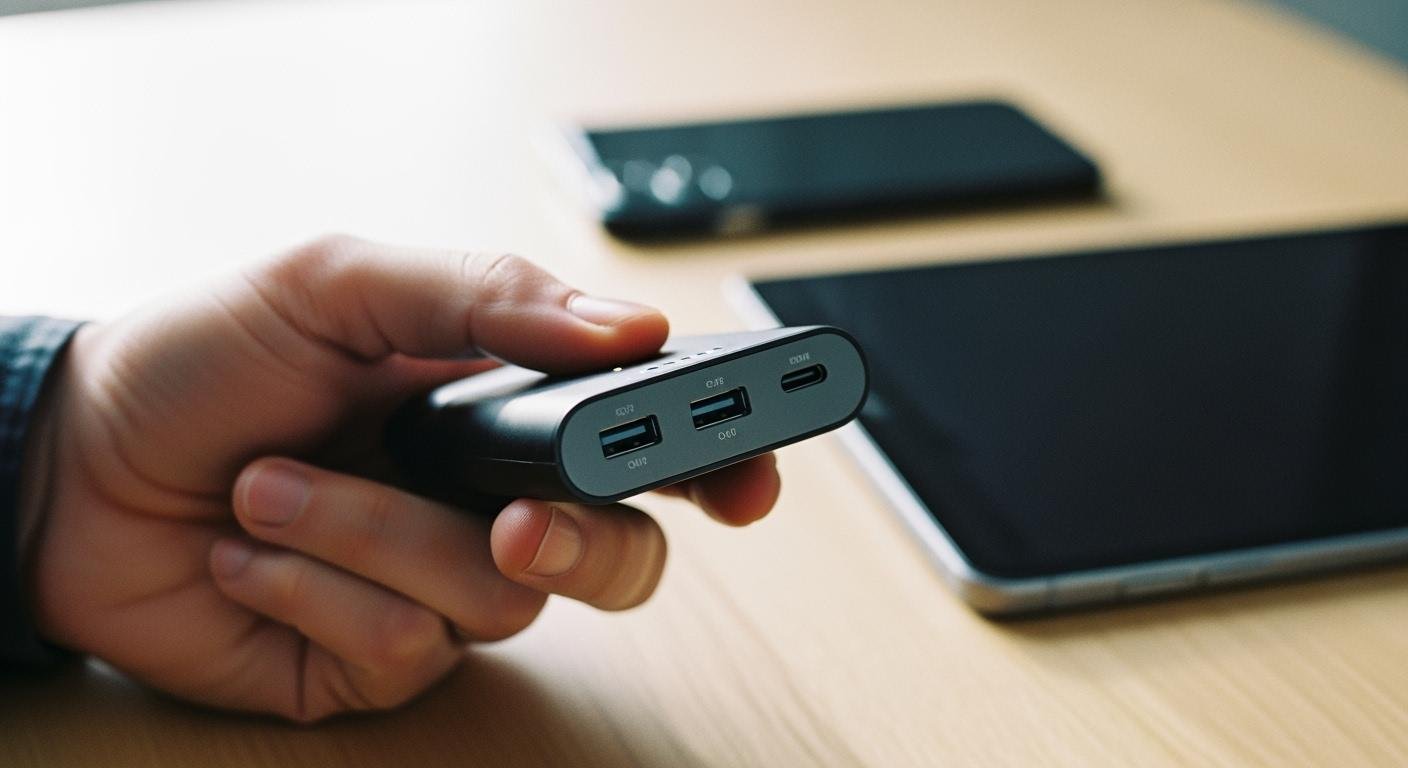
You want to pick a good battery pack for your devices. The market for portable battery packs is growing fast. This shows how many people need power on the go.
| Métrica | Valor |
|---|---|
| Market Size in 2023 | USD 12.29 Billion |
| Market Forecast in 2032 | USD 34.91 Billion |
| Growth Rate (CAGR) | 12.42% (2024-2032) |
To find the best portable option, you must understand three things. These are capacity, charging speed, and size. This guide makes these concepts simple for your devices.
How to Pick a Good Battery Pack: First Steps
You need to look at the technical details to pick a good battery pack. These details tell you how much power the battery holds and how fast it can charge your devices. Let’s break down the three most important numbers: capacity (mAh), total energy (Wh), and output speed (Watts).
Understanding Power Bank Capacity (mAh)
You will see milliamp-hours (mAh) on every power bank. This number tells you the battery’s storage capacity. A higher mAh number means more stored power. This allows for more charges or charging larger devices.
First, you should know the battery capacity of your own devices. Modern smartphones have different battery sizes.
| Smartphone Model | Battery Capacity (mAh) |
|---|---|
| Samsung Galaxy S24 | 4,000 |
| iPhone 15 | 3,349 |
Nota: A 10,000mAh power bank will not charge a 4,000mAh phone exactly 2.5 times. Energy is always lost during charging. This loss happens for several reasons:
- Heat dissipation
- Voltage conversions
- Internal resistance
- Circuit design
A power bank’s internal cells operate at 3.7 volts (V). Your phone charges at 5V. The power bank must convert the voltage, and this process loses energy. A quality power bank is typically 80% to 90% efficient. This means a 10,000mAh power bank realistically delivers around 6,000mAh to 7,000mAh of usable power.
Here is a simple guide to help you choose a capacity:
- One Full Charge (Daily Use): A 10,000mAh power bank is a great choice. It can charge most smartphones about two times.
- Weekend Trip (Heavy Use): A 20,000mAh power bank is better. It holds enough power to keep multiple gadgets, like a phone and tablet, charged for a full weekend.
Why Watt-Hours (Wh) Matter
Milliamp-hours (mAh) are useful, but Watt-hours (Wh) are a more accurate measure of total energy. Watt-hours account for both capacity (mAh) and voltage (V). This makes it the universal standard for comparing energy, especially for laptops and airline travel.
You can calculate Watt-hours with a simple formula.
Watt-hours (Wh) = (mAh × Voltage) / 1000
Most power banks use a standard voltage of 3.7V for this calculation. So, a 20,000mAh portable charger has 74Wh (20,000 mAh x 3.7V / 1000 = 74 Wh).
Airlines like the FAA and EASA have strict rules about batteries. These rules are based on Watt-hours. Knowing your power bank’s Wh rating is essential for a smooth trip.
| Watt-Hour (Wh) Range | Allowed on Plane? | Airline Approval Needed? |
|---|---|---|
| Under 100 Wh | Yes, in carry-on | No |
| 100–160 Wh | Yes, in carry-on | Yes, prior request |
| Over 160 Wh | No autorizado | No autorizado |
Travel Tip: Always pack your portable power bank in your carry-on bag. Never put it in checked luggage.
Matching Output (Watts) to Your Devices
The output speed, measured in Watts (W), determines how quickly a power bank can charge your devices. A higher wattage means faster charging. Using a low-wattage charger for a high-power device will result in very slow charging speeds. To enable fast charging, the output of your portable charger must match what your device can handle.
- Smartphones: Most modern phones support fast charging. You need a power bank with at least 20W output. For example, the Google Pixel 7 Pro charges best with chargers that deliver 20W or more.
- Tablets and Laptops: These larger devices need more power. An iPad can draw up to 45W, while a MacBook Air often uses a 30W adapter. For these devices, you should look for a power bank with an output of 30W to 100W.
You will also see different fast-charging standards. The two most common are USB Power Delivery (PD) and Qualcomm Quick Charge (QC). USB-PD is the universal standard for USB-C and is used by Apple, Google, and many laptop makers. QC is common in Android devices with Snapdragon chips. To pick a good battery pack, you should choose one that supports the standard your devices use.
| Característica | USB Power Delivery (PD) | Qualcomm Quick Charge (QC) |
|---|---|---|
| Estándar | Universal (USB-IF) | Proprietary (Qualcomm) |
| Compatibilidad | Universal (phones, laptops, tablets) | Primarily for devices with Qualcomm chipsets |
| Max Power | Up to 240W | Over 100W (QC 5) |
| Interface | USB Type-C | USB-A and USB-C |
Choosing a power bank with the right capacity, Wh rating, and output wattage ensures your devices stay charged safely and efficiently.
Balancing Power and Portability
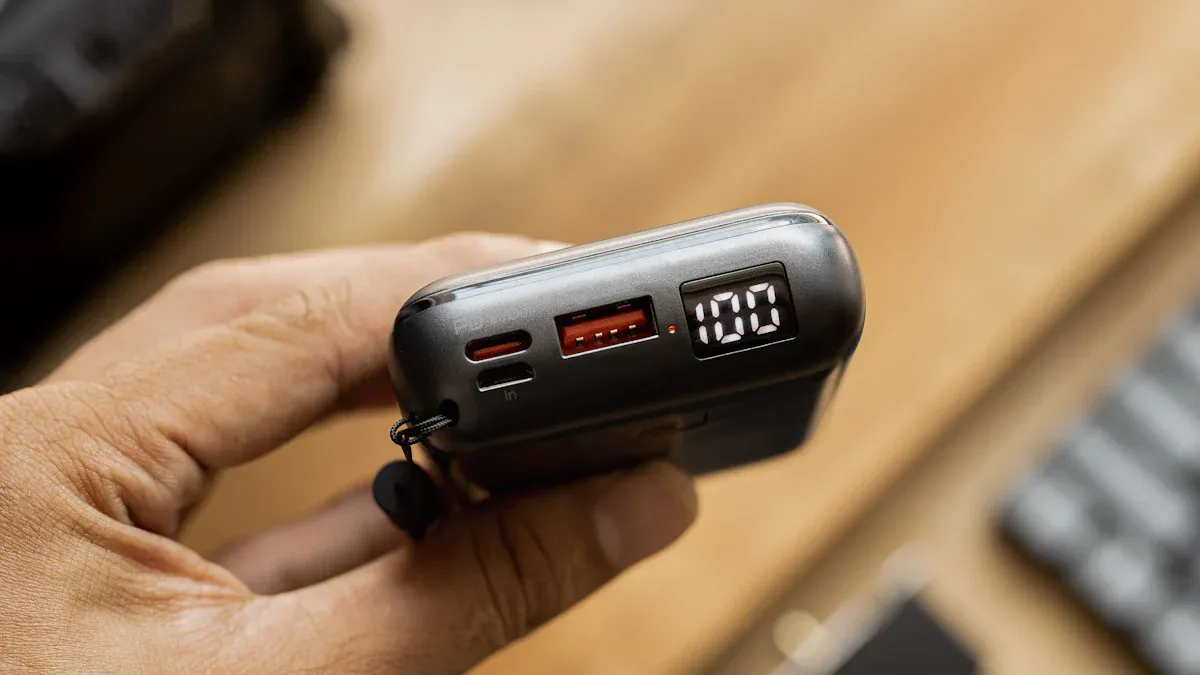
You must find the right balance between power and size. A massive power bank is useless if you leave it at home. A tiny one might not have enough juice. Let’s find the portable option that fits your lifestyle.
Pocket-Sized Packs for Emergencies
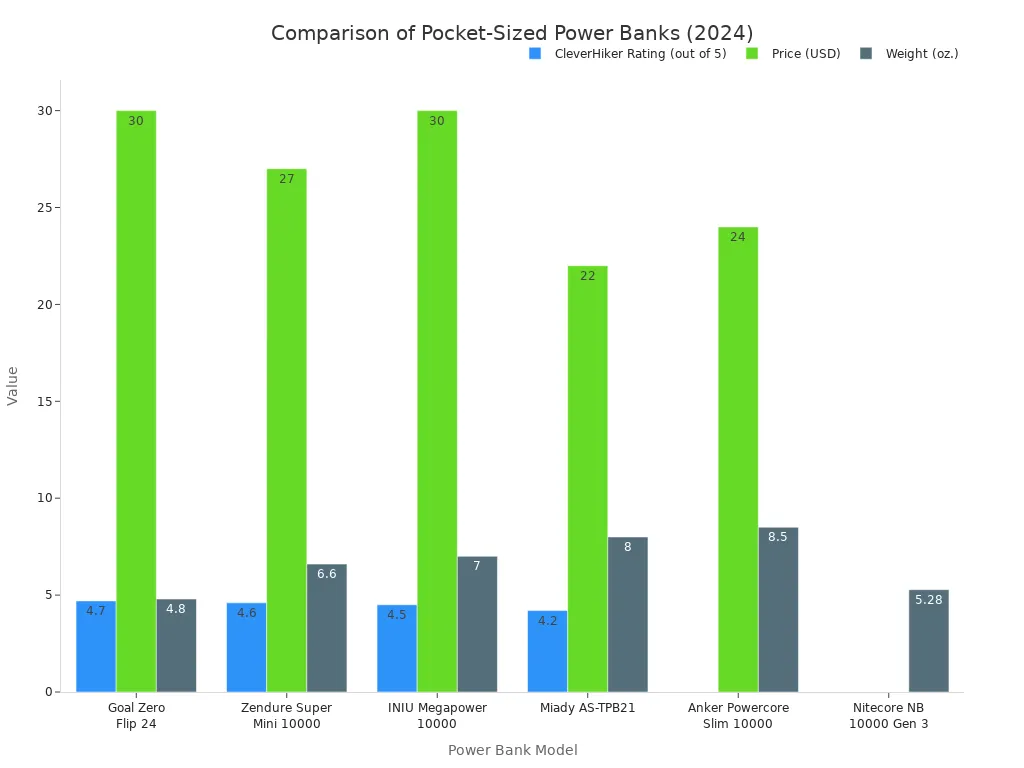
For daily top-ups and emergencies, you should choose a small power bank under 10,000mAh. These portable batteries are lightweight and easy to carry. Models like the Goal Zero Flip 24 y Zendure Super Mini 10000 are praised for their incredibly portable designs. Some of the best power banks, like the Anker MagGo Power Bank (10K, Slim), offer a slim profile. If you have a compatible phone, a MagSafe portable battery offers ultimate convenience.
One of the biggest advantages of a MagSafe Power Bank is its portability. With a compact design, these power banks easily snap onto the back of your device, staying securely in place as you move.
Everyday Carry and Travel Packs
The 10,000mAh to 20,000mAh range is the sweet spot for most users. These portable batteries offer a great mix of power and portability.
- A 10,000mAh power bank is a common and suitable choice for daily use.
- This capacity is reasonably compact and portable.
- It typically provides at least two full charges for a phone.
A 20,000mAh power bank like the Baseus Adaman 65W offers more charges but is heavier, weighing around 350 to 500 grams. This makes it better for a backpack than a pocket. These are some of the best power banks for weekend trips.
Finding the Best Portable Chargers for Business Trips
Business travelers need reliable power for multiple devices. You should look for the best portable chargers with 20,000mAh or more. These high-capacity models can charge a laptop and phone at the same time. The best power banks for business use combine high output, multiple ports, and a professional design. The best power banks are also flight-safe and durable for frequent travel.
| Power Bank Name | Capacidad (mAh) | Max USB-C Output (Watts) | Key Features for Simultaneous Charging |
|---|---|---|---|
| Ugreen Nexode Power Bank 20000mAh 130W | 20,000 | 100 | Multiple ports for simultaneous charging. |
| Anker 737 Power Bank (PowerCore 24K) | 24,000 | 140 | Charges all devices at once without running out of juice. |
| Anker Prime 27,650mAh Power Bank (250W) | 27,650 | 140 | Massive capacity for charging computer, phone, and headphones. |
| INIU B64 140W 27,000mAh Power Bank | 27,000 | 140 | Massive capacity in a compact shape. |
These options ensure your devices stay powered through meetings and travel days.
Identifying the Best Power Banks: Final Checks
You have almost found the perfect portable power bank. Before you decide, you should perform a few final checks. These steps ensure your choice is convenient, safe, and efficient for your daily needs.
Essential Ports and Cables
You need to check the ports on a power bank. Most modern devices use USB-C for fast charging, while many accessories still use USB-A. The best power banks offer both port types for maximum compatibility. Some models even come with built-in cables. This feature offers great convenience but also has downsides.
A power bank with an integrated cable means you never forget it. However, you should consider the trade-offs before buying one.
- Pro: The cable is always attached, so you cannot lose it.
- Pro: It eliminates tangled cords in your bag.
- Con: The cable is often short and cannot be replaced if it breaks.
- Con: You are stuck with one connector type, like USB-C or Lightning.
Key Safety Certifications
Your safety is the most important factor. You should always choose a power bank from a reputable brand like Anker or Nimble Champ. These companies build their products with multiple safety systems. Counterfeit batteries often lack critical protections. This absence can lead to overheating, fires, or even explosions. Authentic batteries include internal safeguards to prevent overcharging and short circuits. Illegitimate versions skip these features, putting your devices and your personal safety at risk. The best power banks protect you from these dangers.
Fast Recharging Input
You want to charge your devices quickly. You also need your portable power bank to recharge fast. The input wattage determines how long this takes. A high input wattage saves you a lot of time. For example, a 20,000mAh power bank can take over 8 hours to recharge with a standard 5W charger. With an 18W fast charging input, that time drops to about 4-6 hours. Some of the best power banks also support pass-through charging. This lets you charge your devices while the portable power bank itself is charging. The best power banks make your life easier.
You can pick a good battery pack by following a few simple steps. First, evaluate your capacity needs and confirm the required charging speed. Next, choose a portable size that fits your lifestyle. Finally, verify the safety features. The best portable battery packs balance power with protection.
For example, a top-rated portable option provides:
- A 10,000 mAh capacity for multiple phone charges.
- 27W USB-C fast charging to power devices quickly.
- A lightweight design perfect for daily commutes.
You now have the knowledge to pick a good battery pack with confidence.
PREGUNTAS FRECUENTES
Can I bring my power bank on an airplane? ✈️
Yes, you can bring a power bank on a plane. You must keep it in your carry-on luggage. Airlines typically limit the size to 100Wh. You may need special permission for power banks between 100Wh and 160Wh.
How long does a power bank last?
A quality power bank should last for 300 to 500 charge cycles. Its ability to hold a full charge will decrease over time. You can expect it to perform well for about two to three years with normal use.
Is it safe to charge my phone overnight with a power bank?
Yes, it is safe if you use a power bank from a trusted brand. These models have important safety features.
Overcharge protection is a key feature. It automatically stops the power flow once your device is fully charged. This protects your phone’s battery health.
Why is my power bank charging my phone slowly?
Slow charging often happens for two reasons. The power bank’s output wattage may be too low for your device. You might also be using a cable that does not support fast charging. Check that your gear is compatible.
 EN
EN ES
ES FR
FR DE
DE RU
RU ZH
ZH