


Lithium polymer batteries held a 42% market share in 2023, yet they come with serious problems. The main disadvantages of lithium polymer batteries include major safety issues, a shorter lifespan, higher costs, and strict handling rules. These disadvantages range from fire hazards to rapid decay. Understanding these risks is critical for any user.
⚠️ Safety Alert: In 2023, New York City alone reported 268 fires and 18 deaths linked to the batteries in e-mobility devices, highlighting the real-world dangers.
Key Disadvantages of Lithium Polymer Batteries
The benefits of lithium polymer batteries come with significant trade-offs. Understanding their core weaknesses is essential for safe and effective use. The primary disadvantages of lithium polymer batteries fall into three main categories: a limited operational life, high production costs, and serious safety concerns.
Shorter Lifespan
LiPo batteries have a surprisingly short life. A typical battery can only handle between 300 and 500 charge cycles. Even without use, they degrade significantly in just two to three years. The most common sign of a failing battery is physical swelling or “puffing.”
⚠️ Advertencia: A swollen or bulging battery is a damaged battery. It has an increased risk of failure and should be decommissioned and disposed of immediately and safely.
This swelling happens because of unwanted chemical reactions inside the battery that create gas. Several factors can cause this breakdown:
- Charging Too Much: Going above the recommended voltage (usually 4,2 V por célula) causes internal parts to break down and release gas.
- Draining Too Low: Letting the voltage drop below the safe limit (around 3.0V per cell) can damage the internal copper components, leading to shorts and more gas.
- Too Much Heat: High temperatures speed up the chemical decay, creating more gas and pressure inside the pouch.
- Age and Use: Simply charging and discharging the battery over time causes natural wear and tear, slowly releasing gas.
Higher Cost
LiPo batteries are more expensive to manufacture than standard cylindrical lithium-ion cells. The complex process of creating the semi-solid gel electrolyte is a major reason for the higher price tag. This delicate production requires specialized equipment and strictly controlled environments, driving up costs.
| Manufacturing Factor | Contribution to Higher Cost |
|---|---|
| Raw Materials | Specialized materials like the polymer separator and aluminum laminate film must be purchased in bulk to be cost-effective, which is difficult for smaller production runs. |
| High Customization | LiPo batteries are often made in custom shapes and sizes. Each new design requires unique molds, new engineering, and process adjustments, making small orders very costly. |
| Rigorous Testing | Every new battery model must pass expensive and time-consuming safety certifications like UL2054, IEC 62133y UN 38.3 before it can be sold or transported. |
Major Safety Risks
The most critical drawback of LiPo batteries is the risk of thermal runaway. This is a dangerous chain reaction where the battery overheats uncontrollably, often resulting in a violent fire. The soft pouch casing offers little protection from physical damage, making them more vulnerable than hard-cased batteries.
Key triggers for thermal runaway include:
- Physical Damage: Puncturing, crushing, or even denting the battery can cause an internal short circuit.
- Overcharging: Pushing too much electricity into the battery creates intense heat and pressure.
- High-Rate Charging: Charging the battery too quickly generates excess heat, increasing risk.
Real-World Examples of LiPo Failures
- An RC hobbyist left a battery charging overnight with the wrong charger. The battery overheated, caught fire, and destroyed the workspace.
- During a race, an RC car crashed and the battery was punctured. It immediately burst into flames on the track.
These safety issues are among the most serious disadvantages of lithium polymer batteries and demand strict handling protocols from every user.
Performance and Energy Density Limits
While LiPo batteries are known for being lightweight, they have clear limits in performance and energy storage. These disadvantages affect how much power they can hold and how efficiently they deliver it.
Lower Energy Density
Energy density measures how much power a battery can store for its weight. LiPo batteries have a lower energy density compared to newer battery technologies. This means they hold less energy than a newer battery of the same size. As technology advances, this gap is becoming more obvious.
For example, emerging solid-state batteries promise significant improvements. A recent prototype from Mercedes and Factorial achieved an energy density of 450 Wh/kg. This new battery is 33% smaller and 40% lighter than a comparable LiPo battery.
| Tipo de batería | Densidad energética (Wh/kg) |
|---|---|
| Lithium Polymer (LiPo) | 160–250 |
| Solid-State (Prototype) | 250–800 |
This lower energy density is a key disadvantage for devices where both weight and long runtime are critical.
High Internal Resistance
Every battery has internal resistance (IR), which is like friction for electricity. It resists the flow of energy. High internal resistance is a major performance drawback in LiPo batteries.
What is Voltage Sag? When you use a battery, high IR causes the voltage to drop suddenly. This effect is called “voltage sag.” It can trick your device into thinking the battery is empty, even when it still has power left.
High IR wastes energy by turning it into heat. It also causes significant voltage sag under heavy use. A battery with high IR cannot deliver power effectively. For instance, a drone might report a low battery and land early because the voltage dropped too much, not because the battery was truly empty.
As a LiPo battery ages, its internal resistance increases. This makes the battery run hotter and become less efficient. This buildup of heat is a primary cause of battery swelling, signaling that the battery is failing and unsafe to use.
Critical Safety and Handling Protocols
The lightweight power of lithium polymer batteries comes with a serious responsibility. Users must follow strict safety and handling rules. These protocols are not optional suggestions; they are essential for preventing property damage, injury, and even death.
Risks of Lithium Polymer Batteries
The single greatest danger of a LiPo battery is thermal runaway. This is a rapid, uncontrolled chain reaction that causes extreme heat. The battery can swell, vent hot gas, and burst into violent flames. The soft pouch design of these batteries offers very little protection. A simple drop, crush, or puncture can trigger a catastrophic failure.
Many fires in RC hobbies and drone operations are traced back to a few common mistakes. Understanding these triggers is the first step to preventing them.
- Improper Charging: Using the wrong charger or setting incorrect parameters is a leading cause of fires.
- Physical Damage: Crashing a drone or dropping a battery can cause internal shorts, leading to immediate failure.
- Short Circuits: Allowing the battery’s positive and negative terminals to touch a metal object can create a dangerous short circuit.
- Manufacturing Defects: While less common, flaws from the factory can create a hidden risk.
Strict Charging Rules
Charging is the most dangerous time in a LiPo battery’s life. It requires specific equipment and careful monitoring to avoid overcharging and overheating.
💡 Never Use the Wrong Charger In the RC hobby world, it is well known that charging a LiPo pack without a proper balance charger can lead to “Bad Things.” A fire is a very real possibility.
A specialized balance charger is mandatory. These smart devices monitor the voltage of each individual cell within a battery pack. This ensures every cell is charged equally, preventing one from being overcharged while another is undercharged. A modern balance charger can handle multiple battery types and has built-in safety features.
Discharging a battery too far also causes permanent damage. A LiPo cell should never drop below 3.0V. When the voltage gets too low, the internal chemistry breaks down.
- Below 3.7V: The battery’s internal resistance starts to increase permanently.
- Below 3.0V: Significant and irreversible damage occurs.
- Below 2.5V: The battery is often considered too hazardous to recharge. The high internal resistance can cause extreme overheating during a charge cycle.
Attempting to charge a cell that has been over-discharged is extremely risky and a common cause of sobrecarga incidents, as the charger may not read the damaged cell correctly.
Proper Storage and Handling
How you store and handle your batteries directly impacts their lifespan and safety. Following correct procedures for storage, travel, and disposal is critical.
Safe Storage Practices
Proper storage minimizes battery degradation and reduces fire risk. The two most important factors are storage voltage and temperature. For long-term storage, a battery should be at a partial charge, not full or empty. Experts recommend a storage voltage of around 3.92V per cell, which is about 40% capacity.
Storing a fully charged battery, especially in warm conditions, causes rapid capacity loss.
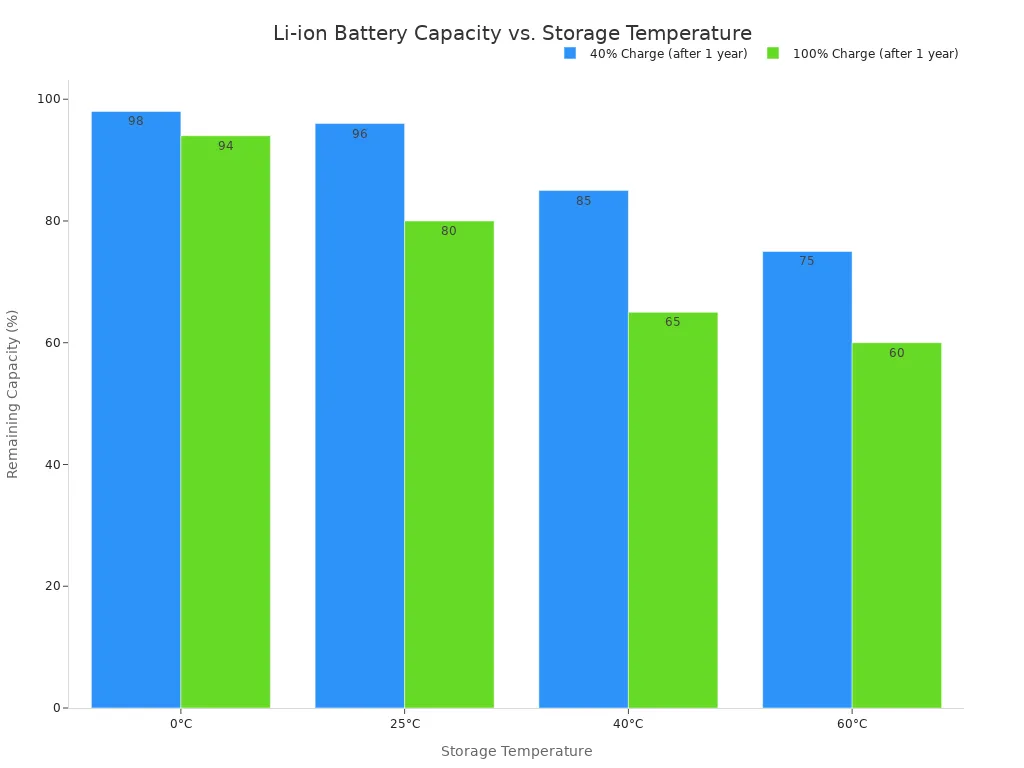
Temperature is just as important. Storing batteries in a cool, dry place is ideal.
| Condición | Recommended Temperature |
|---|---|
| General Use | 40°F to 120°F (4°C to 49°C) |
| Ideal Storage | 68°F to 77°F (20°C to 25°C) |
⚠️ Advertencia: Never store LiPo batteries in a freezing environment. Cold temperatures below 32°F (0°C) can cause lithium plating on the anode, which can lead to internal short circuits and thermal runaway when the battery is used or charged next.
For an extra layer of safety, always store batteries in a fire-resistant LiPo bag. These bags are made from a fiberglass woven fabric designed to contain a fire if a battery fails during storage or charging.
Handling and Transport
When traveling by air, you must follow strict rules. The Federal Aviation Administration (FAA) has specific guidelines based on a battery’s watt-hour (Wh) rating.
- 0-100 Wh: Allowed on planes.
- 101-160 Wh: Allowed, but you need airline approval first.
- Over 160 Wh: Prohibited from passenger aircraft.
Disposing of Damaged Batteries
A swollen, puffy, or damaged battery is a fire hazard and must be decommissioned safely. Never throw it in the regular trash.
Safety First: How to Handle a Damaged Battery
- Protect Yourself: Work in a well-ventilated area, preferably outdoors. Wear safety goggles and gloves.
- Prepare Your Space: Have a fireproof container, like a metal bucket with sand, ready. Work on a non-flammable surface.
- Discharge the Battery: If possible, safely discharge the battery to 0V to make it inert. You can do this by connecting it to a LiPo discharger or a small load like an LED light.
- Remove with Care: Use only plastic tools to remove a swollen battery from a device. Never use sharp metal objects that could puncture it.
- Dispose Properly: Take the fully discharged and stable battery to a local e-waste collection site or a battery recycling center. Never mail a damaged battery.
In summary, the primary disadvantages of lithium polymer batteries are their significant safety risks, short lifespan, higher cost, and demanding handling needs. These issues represent major trade-offs for their lightweight advantage. Users must understand that this technology requires a serious commitment to safety and maintenance.
💡 Final Takeaway: To safely use this battery chemistry, you must be prepared to follow strict protocols. Diligent care is the only way to manage the inherent disadvantages of lithium polymer batteries and prevent accidents.
PREGUNTAS FRECUENTES
What is the biggest risk with LiPo batteries?
The biggest risk is thermal runaway. This dangerous event causes the battery to overheat uncontrollably. It can lead to a violent fire or explosion. The battery’s soft pouch offers little protection from physical damage, which can easily trigger this reaction.
How can I tell if my LiPo battery is bad?
The most obvious sign is physical swelling or “puffing.” A puffy battery is damaged and unsafe. You should stop using it immediately. Safely discharge and dispose of it at a proper recycling facility. Never use a swollen battery.
How long do LiPo batteries actually last?
A LiPo battery has a short lifespan. It typically lasts for 300 to 500 charge cycles. Even if you do not use it, the battery will degrade and lose capacity in just two to three years.
Why are LiPo batteries more expensive? 💰
LiPo batteries cost more due to their complex manufacturing. Making the gel electrolyte is a difficult and expensive process. They are also often produced in custom shapes, which increases production costs compared to standard cylindrical cells.
 EN
EN ES
ES FR
FR DE
DE RU
RU ZH
ZH