

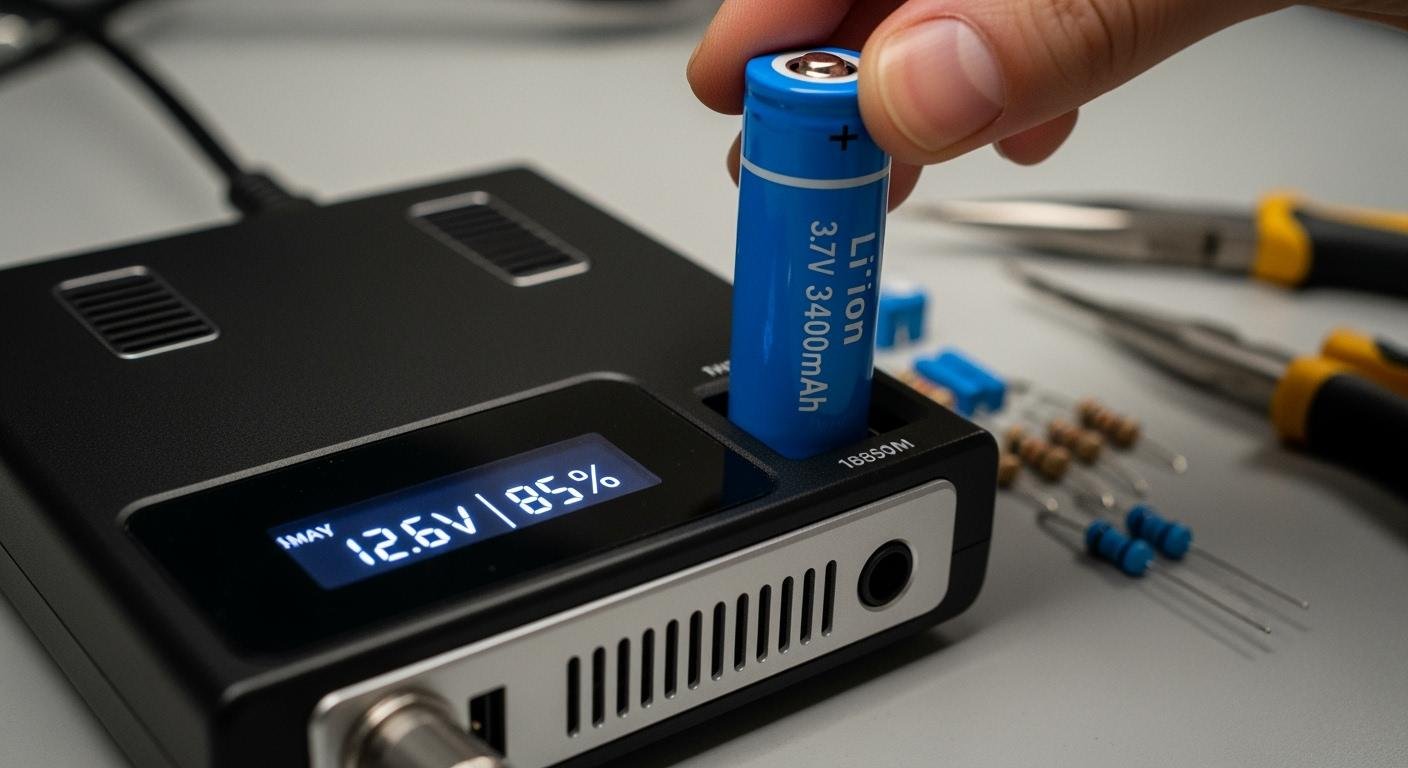
Yes. You absolutely need a special battery charger for your lithium battery. Using a special charger is the only way to protect your investment.
Why is it essential? A dedicated charger for lithium batteries ensures three key things:
- Sicherheit: It prevents dangerous overcharging.
- Lebenserwartung: It helps your lithium battery last for its maximum number of cycles.
- Leistung: You get 100% of the power and capacity from your lithium setup.
Why Standard Chargers Damage Lithium Batteries
You might think a charger is just a charger. However, using a standard charger designed for lead-acid batteries on your advanced lithium setup is a recipe for damage. These chargers use a charging language that lithium batteries simply do not understand. This mismatch can shorten your battery’s life, reduce its performance, and even create safety hazards.
The Incompatible Charging Stages
Standard chargers typically follow a three-stage charging process for lead-acid batteries: Bulk, Absorption, and Float. This algorithm is fundamentally different from what a lithium battery needs.
- Lead-Acid Charging: Uses a constant voltage approach. The charger holds the voltage steady and lets the current naturally decrease as the battery fills up.
- Lithium Charging: Requires a Constant Current/Constant Voltage (CC/CV) profile. The charger provides a steady current until the battery reaches a specific voltage. Then, it holds that voltage constant while the current tapers off. Once the current drops to a very low level, the charger shuts off completely.
The most damaging stage from a lead-acid charger is the final “float” or “trickle” charge. Lead-acid batteries have a high self-discharge rate, so a continuous low-voltage charge (around 13.5 to 13.8 volts) keeps them topped off.
Warning: Float Charging Kills Lithium Your lithium battery cannot absorb overcharge. A continuous float charge, even a small one, keeps the battery at its maximum voltage. This constant stress can cause metallic lithium to plate onto internal components, permanently reducing capacity and compromising safety. For a long and healthy life, a lithium charger must cut off the current completely once the battery is full.
Risks of Undercharging and BMS Confusion
Using a standard charger often leads to chronic undercharging. The voltage settings for a lead-acid charger are too low for a lithium battery. As a result, your charger will shut off too early, thinking the battery is full when it has only reached 80-90% of its actual capacity. You never get the full power you paid for.
This consistent undercharging creates a bigger problem: it confuses your battery’s onboard computer, the Battery Management System (BMS).
The BMS tracks the battery’s State of Charge (SOC). When you fail to perform regular full charge cycles, the SOC calculator can drift and become inaccurate over time. Your BMS might report that you have 50% capacity left when you only have 10%. This unreliable reading can leave you without power when you least expect it. This process also leads to cell imbalance, where some cells inside the battery pack work harder than others, reducing the overall usable capacity of your lithium investment by 5-15%.
The Danger of Equalization Mode
Many advanced lead-acid chargers include an automatic “equalization mode.” This feature is the single most dangerous thing you can expose your lithium batteries to.
Equalization mode is designed to fix imbalances in lead-acid cells by applying a controlled overcharge at a very high voltage, often over 15.5 volts. If you apply this voltage to a lithium chemistry, the results are catastrophic.
| Aktion | Consequence for a Lithium Battery |
|---|---|
| High Voltage Applied | The charger forces voltage far beyond the safe limit for lithium, bypassing the BMS’s normal protections. |
| Internal Stress | Excess lithium ions are forced into the battery’s structure, causing physical stress and generating intense heat. |
| Permanent Damage | This process can cause lithium plating, which is irreversible. It permanently destroys capacity and shortens the battery’s life. |
| Safety Risk | In severe cases, the extreme heat can damage the internal separator, creating a risk of a short circuit and thermal runaway—a dangerous chain reaction. |
Even one equalization cycle can permanently damage your expensive lithium batteries. It is crucial to ensure any charger you use does not have an automatic, non-defeatable equalization mode.
The “Special” Lithium Charging Profile

A special charger understands the unique language of a lithium battery. It uses a specific, multi-stage process called optimized lithium charging. This process ensures your battery gets exactly the power it needs without stress or damage. It is the correct way of charging lithium batteries.
The Optimal Charge Profile for a Lithium Battery
The ideal profile for charging a lithium battery is called Constant Current/Constant Voltage (CC/CV). It works in two main stages:
- Constant Current (CC): The charger delivers a strong, steady current. This quickly brings your battery to about 70% of its capacity.
- Constant Voltage (CV): The charger then holds the voltage steady. The current gradually drops as the battery safely absorbs the remaining power. The charger shuts off completely when the current falls to a very low level.
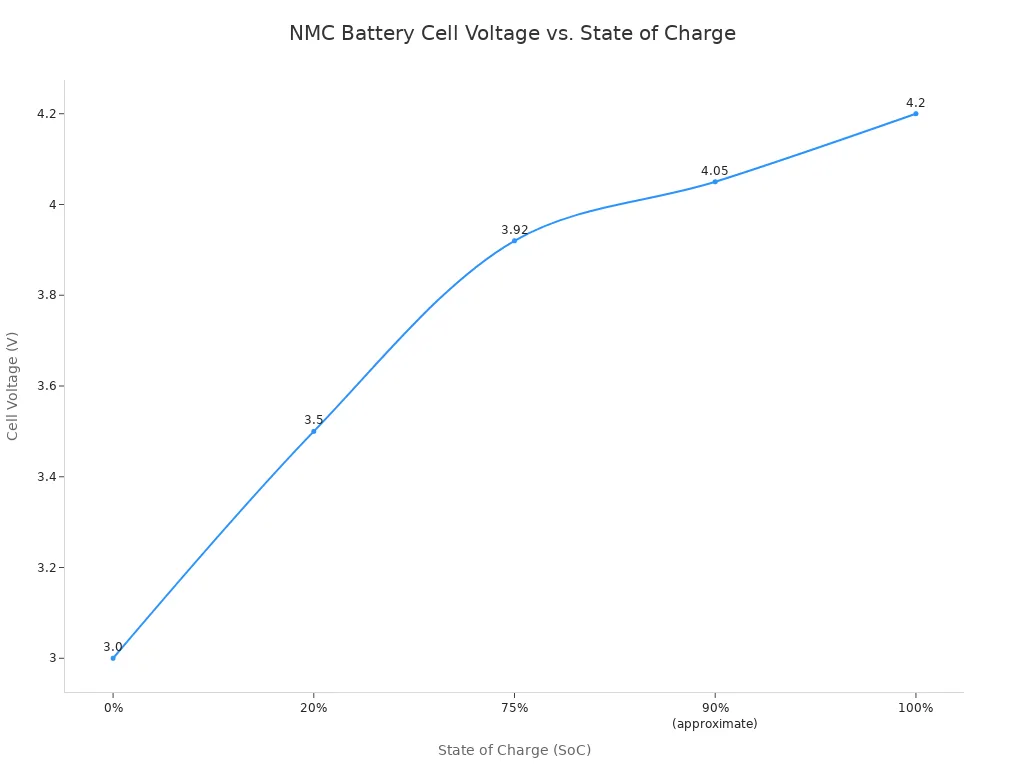
Different lithium chemistries have unique charging requirements. For example, a LiFePO4 battery has a very flat voltage curve, while an NMC lithium battery shows a more gradual voltage increase as it charges. A smart charger knows these differences.
How Smart Chargers and the BMS Work Together
Your charger and the Battery Management System (BMS) work as a team. The BMS is the brain of your lithium battery, and the smart charger is its trusted partner.
A Perfect Partnership In advanced systems, the BMS communicates directly with the charger using protocols like CAN Bus. It sends vital information about the battery’s temperature, voltage, and state of charge. This allows the charger to adjust its output in real-time for a perfect charge. The BMS can also physically stop the current if it detects a problem, acting as the ultimate safety guard.
Why Trickle Charging Is Unnecessary
Sie sollten never trickle charge a lithium battery. Unlike lead-acid batteries, lithium batteries do not need a constant top-off charge.
The reason is simple: lithium has an extremely low self-discharge rate, losing only about 2-3% of its charge per month. It holds power very efficiently on its own. A continuous trickle charge keeps the battery at maximum voltage, which causes stress and promotes internal damage like lithium plating. This permanently reduces your battery’s capacity and lifespan. A proper lithium charger turns off completely once the job is done.
How to Choose the Right Special Battery Charger
Selecting the right charger for your lithium battery depends on your primary use case. You need to consider if you will be charging at home from a wall outlet or on the move in a vehicle. Let’s break down the best options for each scenario.
For Stationary Charging at Home
When you charge your battery at home or in your workshop, you use an AC wall outlet. For this, you need a dedicated AC-to-DC charger that has a specific setting for lithium batteries. These lithium-specific chargers are designed to provide the correct multi-stage charging algorithm. They ensure the right voltage and current are delivered at the proper times, which is essential for protecting your battery’s performance and safety.
A key decision is choosing the right charger size, measured in amps. A general guideline is to use a current that is 10-50% of your battery’s capacity. For a 100Ah battery, this means a battery charger between 10 and 50 amps is a great choice.
| Charger Amperage | For a 100Ah Battery | Am besten für |
|---|---|---|
| 10-20 Amps | Slower Charge | Maximizing battery lifespan with very low heat. |
| 25-50 Amps | Faster Charge | Balancing charging speed and long-term health. |
While faster charging is convenient, it can generate more heat and stress. You must find a balance between speed and longevity. The right charger will also manage cell balancing. This process is crucial for keeping all the individual cells inside your lithium battery at the same voltage.
How Smart Chargers Balance Cells A lithium-specific charger works with the BMS to prevent any single cell from overcharging.
- It monitors the voltage of each cell during the final charging stage.
- If one cell reaches its maximum voltage before others, the charger helps the BMS to redirect energy.
- This ensures all cells arrive at a full charge together, preventing internal stress and maximizing capacity.
For Charging on the Go
Charging your auxiliary lithium battery in an RV, van, or boat presents a unique challenge. The power source is your vehicle’s alternator, which is a DC system. You might be tempted to connect your lithium battery directly to your vehicle’s starting battery or alternator. You should never do this.
🚨 Warnung: Alternators Can Destroy Lithium Batteries Directly connecting a lithium battery to your alternator is dangerous for several reasons:
- Alternator Overheating: Lithium batteries can draw a huge amount of current. This demand can force your alternator to run at maximum output for long periods, causing it to overheat and fail prematurely.
- Voltage Spikes: If your battery’s BMS suddenly disconnects to prevent overcharging, it can create a massive voltage spike that can damage your alternator and other vehicle electronics.
- Suboptimal Charging: A stock alternator does not provide the stable, regulated voltage that a lithium battery needs, leading to undercharging and a shorter lifespan.
The correct and safe solution is a special battery charger called a DC-to-DC charger. This device is the perfect middleman between your alternator and your lithium battery. It isolates your sensitive electronics, protects your alternator, and delivers a perfect charge. A DC-to-DC charger takes the fluctuating power from your alternator and converts it into a stable, multi-stage output optimized for lithium. Popular options like the Victron Orion-Tr Smart or the EcoFlow Alternator Charger are designed specifically for this purpose in 12V or 24V systems.
A special battery charger is not an optional accessory for your lithium battery. It is a necessary tool to protect your investment in lithium technology.
Using the correct special battery charger for your lithium battery ensures you get 100% of its power. It also maximizes the lifespan of all your lithium batteries.
This simple choice saves you money and frustration with your lithium setup. You get the full performance you paid for and a battery that lasts for years.
FAQ
Can I use a lead-acid charger that has a lithium mode?
Yes, you can. A charger with a specific lithium (like LiFePO4) setting is designed to be safe. This mode uses the correct Constant Current/Constant Voltage (CC/CV) profile. You must make sure you select the lithium setting before you begin charging your battery.
What happens if I use the wrong charger just once?
Using the wrong charger, even one time, is risky. It will likely undercharge your battery. If the charger has an automatic equalization mode, it can permanently damage your battery in a single use. You should always avoid this risk to protect your investment.
How do I know if my charger has an equalization mode?
You can find this information in your charger’s user manual or on its label. Look for words like “Equalize,” “Recondition,” or “Desulfation.” Some chargers may have a specific button for this feature. When in doubt, you should contact the manufacturer for confirmation.
Can I leave my lithium battery on the charger?
You should not leave your lithium battery on a charger for long periods. A proper lithium charger automatically shuts off when the battery is full. Lithium batteries do not need a continuous trickle charge.
Tipp: Disconnecting the charger after the battery is full is the best practice for maximizing its lifespan.
 EN
EN ES
ES FR
FR DE
DE RU
RU ZH
ZH