


All 2025 Tesla vehicles run on Lithium-Ion batteries. The specific chemistry and physical format, however, vary significantly. The type of battery a Tesla uses depends on the car’s model, trim, and even its factory of origin. The company chooses between two main chemistries:
- Lithium-Eisen-Phosphat (LFP)
- High-nickel chemistries (NMC, NCA, NCMA)
These chemistries are packaged into different cell formats, primarily the established 2170 cells and the newer 4680 structural cells. This variation is a key part of Tesla’s manufacturing strategy.
What Batteries Does Tesla Use in 2025?
Tesla’s battery choice for each vehicle is a deliberate part of its global strategy. The company matches specific battery chemistries and cell formats to a model’s intended purpose, balancing cost, range, and performance. This means the battery in a standard range car is very different from the one in a high-performance Plaid model.
Here is a quick overview of the batteries found across the 2025 Tesla lineup.
| Modell | Trim(s) | Batteriechemie | Cell Format | Primary Supplier(s) |
|---|---|---|---|---|
| Model 3 | Standard Range RWD | LFP | 2170 | CATL |
| Long Range, Performance | NMC / NCMA | 2170 | Panasonic, LG | |
| Model Y | Standard Range RWD | LFP | 2170 | CATL |
| Long Range, Performance | NMC | 2170 | Panasonic, LG | |
| AWD (from Giga Texas) | High-Nickel | 4680 | Tesla | |
| Model S/X | All Trims | NCA | 18650 | Panasonic |
| Cybertruck | All Trims | High-Nickel | 4680 | Tesla |
Model 3: LFP and NMC/NCMA Options
The Tesla Model 3 demonstrates the company’s dual-battery approach perfectly. The entry-level Standard Range Rear-Wheel Drive (RWD) model uses a Lithium Iron Phosphate (LFP) battery pack. These durable and affordable cells primarily come from the supplier CATL.
For drivers wanting more range and power, the Long Range and Performance trims use a different strategy. These cars feature high-nickel battery packs with either NMC (Nickel Manganese Cobalt) or NCMA (Nickel Cobalt Manganese Aluminum) chemistry. These cells offer greater energy density.
- Panasonic supplies many of the high-nickel cells for cars built in the US from its Giga Nevada facility.
- LG Energie Lösung provides NCM cells from its Nanjing plant for Model 3s sold in Europe and Asia.
All current Model 3 versions use the 2170 cylindrical cell format.
Model Y: LFP, NMC, and 4680 Cells
The Tesla Model Y has the most diverse battery lineup. Like its smaller sibling, the base Standard Range RWD Model Y uses an LFP battery pack with a capacity of around 60 kWh. The popular Long Range and Performance all-wheel drive models use a higher-density 75 kWh NMC battery pack for increased range and acceleration.
The big news for the Model Y is the introduction of Tesla’s own 4680 cells.
A New Generation: Certain Model Y AWD vehicles built at Gigafactory Texas are equipped with a Structural Battery Pack containing 4680 cells. CEO Elon Musk confirmed this shift, marking a new era in Tesla’s manufacturing process.
This means a Model Y’s battery can be LFP, NMC, or the new 4680 type, depending on its trim level and where it was built. The specific battery chemistry Tesla use in the 4680 cells is a high-nickel formula.
Model S & X: Premium NCA Batteries
Tesla’s flagship Model S and Model X vehicles prioritize maximum range and performance. To achieve this, they exclusively use battery packs with a high-performance NCA (Nickel Cobalt Aluminum) chemistry. These packs have a large 100 kWh capacity.
Panasonic is the primary and long-standing supplier for these vehicles. It manufactures the cells in Japan and at Gigafactory Nevada. Interestingly, the Model S and X do not use the newer 2170 or 4680 cells. Instead, they rely on the smaller, time-tested 18650 cylindrical cell format. A single battery pack contains 16 modules, holding over 7,000 individual cells to deliver its impressive power.
Cybertruck: The 4680-Powered Truck
The Tesla Cybertruck is built entirely around the new 4680 cell technology. Every Cybertruck features a structural battery pack that forms part of the truck’s frame. This innovative design is only possible with the 4680 cells that Tesla produces in-house.
The massive battery pack has a total capacity of 123 kWh. It contains 1,366 individual 4680 cells. This large pack gives the Cybertruck an official EPA-estimated range of 320 to 350 miles, depending on the specific configuration. The battery technology is a core part of what makes the Cybertruck’s unique design and capabilities possible. The battery chemistry Tesla use here is a specialized high-nickel formula optimized for the new cell format.
LFP vs. Nickel-Based Batteries
The battery inside a Tesla does more than just power the car; it defines the daily ownership experience. The choice between a Lithium Iron Phosphate (LFP) battery and a high-nickel (NMC/NCA) battery affects charging routines, performance, and even how the car behaves in winter. Understanding these differences helps owners get the most out of their vehicles.
Daily Charging Habits
A car’s battery chemistry directly dictates the best daily charging practice. This is one of the most significant practical differences for an owner.
- LFP Batteries (Standard Range models): These batteries are robust and prefer to be fully charged. Tesla recommends charging LFP-equipped cars to 100% at least once per week. This helps the Battery Management System (BMS) accurately calculate the available range. The battery’s flat voltage curve makes it hard for the BMS to estimate the charge level without a full recalibration.
- Nickel-Based Batteries (Long Range/Performance models): These batteries have higher energy density but are more sensitive to high states of charge. To maximize battery lifespan, owners should set the daily charge limit to 80% or 90%. This practice minimizes stress on the cells and preserves long-term health.
Owner’s Tip: Check your car’s charging screen. A Tesla with an LFP battery will show a “Daily” and “Trip” range on the charging slider, encouraging a 100% charge. A car with a nickel-based battery will recommend a limit of 80-90% for daily use.
Range and Performance
Nickel-based batteries hold more energy in the same amount of space. This is called energy density. Higher energy density translates directly to longer range and quicker acceleration.
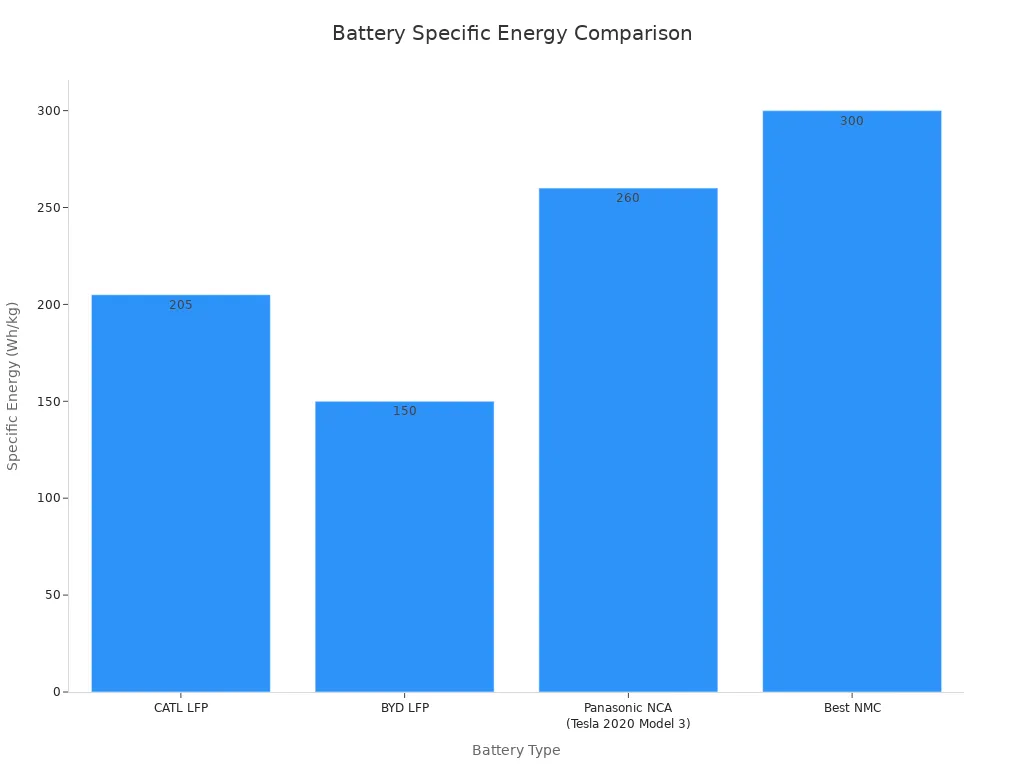
Because LFP batteries have a lower energy density, the car needs more of them to achieve a similar range. This adds weight. The extra weight can slightly reduce acceleration. For example, a 2022 Model 3 with an LFP battery has a 0-60 mph time of 5.8 seconds, which is a bit slower than previous models that used nickel-based cells. The high-nickel batteries in Performance and Long Range models provide the instant torque and extended range those trims are known for.
Cold Weather Impact
All electric vehicle batteries lose some performance in cold weather. However, LFP batteries are generally more affected by low temperatures than their nickel-based counterparts.
| Temperature (°C) | LFP Capacity Retention (%) | NMC Capacity Retention (%) |
|---|---|---|
| 0°C (32°F) | 85% | 78% |
This table shows that while both chemistries lose capacity, the practical impact on LFP batteries is often more noticeable to the driver. In cold climates, an LFP battery owner may experience:
- More significant temporary range loss.
- Slower DC fast charging speeds, as the battery must warm up before accepting a high rate of charge.
- Reduced regenerative braking, as the cold battery cannot capture as much energy.
Nickel-based NMC and NCA batteries are less sensitive to the cold. They can generally charge faster and offer more consistent performance in winter conditions.
Cost and Longevity
This is where LFP batteries truly shine. The primary advantage of the LFP chemistry is its lower cost and exceptional durability.
LFP-Batterien do not use cobalt, a rare and expensive material. This makes the battery packs significantly cheaper to produce. In 2024, LFP cell prices in China dropped below $60 per kWh, making affordable EVs possible. The battery chemistry Tesla use in its standard range models helps keep the final vehicle price down for consumers.
In terms of longevity, LFP batteries are champions. They can handle a much higher number of full charge-discharge cycles before they begin to degrade. Charging an LFP battery to 100% regularly does not harm it nearly as much as it would an NMC or NCA battery. This durability means an LFP pack can last for many years and miles, offering excellent long-term value.
The 4680 Cell and Structural Packs
The 4680 cell represents a major leap forward in Tesla’s battery technology. It is not just a new battery but a core part of a new manufacturing philosophy. This approach combines the cell, the battery pack, and the car’s frame into a single, unified system.
What Is a 4680 Cell?
The 4680 cell gets its name from its dimensions: 46 millimeters in diameter and 80 millimeters in height. This larger cylindrical format holds more energy than the older 18650 or 2170 cells. Its real innovation, however, lies in its internal design.
- Tabless Electrode Design: This key feature creates a shorter path for electricity to travel. It dramatically lowers internal resistance, which reduces heat buildup.
- Improved Thermal Performance: Because the cell generates less heat, it can be charged and discharged much faster without degrading. This design helps prevent a problem called lithium plating during fast charging.
- Hohe Energiedichte: The cell uses a high-nickel NCM811 chemistry. This gives it a high energy density, packing more power into a smaller space.
The Structural Battery Pack
Tesla uses the 4680 cells to create a structural battery pack. This means the battery pack is no longer just a component placed inside the car. Instead, it becomes a part of the vehicle’s frame. The cells are integrated directly into the chassis, making the entire structure stronger and lighter.
This design offers several benefits. It improves the car’s torsional rigidity, or resistance to twisting, which enhances handling and safety. By making the battery a part of the structure, Tesla removes redundant parts, leading to a 10% weight reduction in vehicles like the Model Y.
This “Cell-to-Chassis” approach is a game-changing manufacturing process. It combines the battery and chassis assembly into one step, saving time, reducing complexity, and lowering production costs.
Which Teslas Use 4680 Cells?
The 4680 cell and structural pack are central to Tesla’s newest vehicles.
- Die Tesla Cybertruck was designed from the ground up around this technology. Every Cybertruck uses a 4680 structural pack.
- Certain Tesla Model Y vehicles built at Gigafactory Texas also use 4680 cells. For 2025, the Model Y Long Range and Performance trims are confirmed to use these next-generation batteries.
This technology is a key part of Tesla’s strategy to build more efficient, lower-cost, and better-performing electric vehicles.
How to Identify Your Tesla’s Battery
Knowing your Tesla’s battery type is simple. The car provides clear information directly through its software. An owner can use the charging screen or the vehicle information menu to find the exact battery chemistry.
Using the Charging Screen
The easiest way to identify the battery is by looking at the charging screen in the car or the Tesla app. The software gives different recommendations based on the battery chemistry.
The Tesla app displays a specific message for LFP battery owners: “Charge to 100% at least once per week to maintain accuracy.” In contrast, for NCA/NCM battery owners, the app advises: “Set daily limit to 80% for optimal battery health.”
These distinct messages are a clear indicator of the high-voltage battery type installed in the vehicle.
Checking Vehicle Information
For a definitive confirmation, owners can check the car’s software menu. This menu explicitly states the battery chemistry. You can verify your Tesla’s battery type with these simple steps:
- On the car’s main touchscreen, tap
Controls. - Navigate to the
Softwaretab. - Select the
Additional Vehicle Informationoption.
A window will appear that lists key details about the car, including “High Voltage Battery type,” which will show either Lithium Iron Phosphate or a Nickel-based chemistry.
The Low-Voltage LFP Battery
Tesla is also upgrading its smaller 12-volt accessory battery. The company is replacing the traditional 12V lead-acid battery with a more advanced 16-volt LFP battery. This low-voltage system powers the car’s electronics, lights, and computers. This change offers several key benefits:
- It has a much längere Lebenserwartung, reducing the need for replacements.
- The battery is lighter, which helps with overall vehicle efficiency.
- It offers superior energy efficiency and better performance in cold weather.
- It has a higher cycle life, meaning it can be charged and discharged more times.
This upgrade makes the entire vehicle system more durable and efficient.
The battery Tesla use in a car defines its purpose. The company employs a dual strategy:
- Lithium-Eisen-Phosphat (LFP) batteries make standard range models affordable and durable.
- High-nickel chemistries give premium models their signature long range and performance.
Key Takeaway: Knowing your specific battery type is essential. It allows you to optimize daily charging habits, which directly impacts the vehicle’s long-term health.
Tesla’s strategy is constantly adapting. The future will see further evolution with the full rollout of the 4680 cell, new material innovations, and continued partnerships with key suppliers.
FAQ
Which Tesla battery is best?
The “best” battery depends on an owner’s priorities. LFP batteries offer superior durability and lower cost for daily driving. High-nickel batteries provide the longest range and quickest acceleration. Each chemistry is optimized for a specific use case within Tesla’s lineup.
Why does Tesla use different battery suppliers?
Tesla partners with multiple suppliers like CATL, Panasonic, and LG. This strategy secures a stable battery supply for its global factories. It also allows the company to source the ideal battery chemistry for each specific vehicle model and region.
Will all future Teslas use 4680 cells?
Tesla is expanding its use of 4680 cells in newer vehicles like the Cybertruck. However, the company will likely continue using 2170 cells for many models. This dual-battery approach helps manage production costs and ensures a stable supply for the entire vehicle range.
 EN
EN ES
ES FR
FR DE
DE RU
RU ZH
ZH